
Introduction
Every day, thousands of sourcing managers and optical engineers type “cover lens”, “cover glass”, or “cover lens manufacturer” into Google. Most are left confused by overlapping terms, conflicting supplier claims, and rapidly changing specifications for foldable phones, under-display cameras, and automotive displays.
This article removes the confusion once and for all. Read on and you will know exactly what a cover lens is, which material you should actually choose, the real specifications global Tier-1 brands demand, and how to avoid costly mistakes.
What Exactly is a Cover Lens?
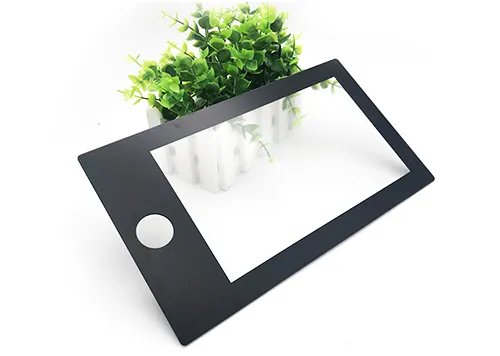
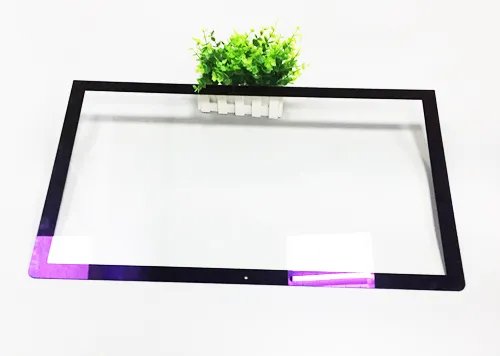
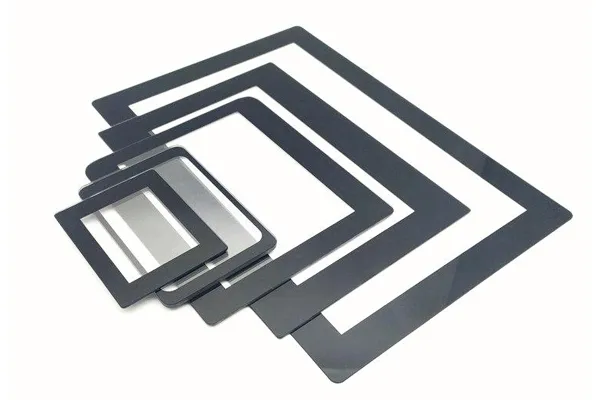
A cover lens, also widely known as cover glass in the industry, is the outermost protective layer of a display, touchscreen, or optical module.
Structurally, it sits at the very top of the stack:
Cover Lens → OCA (Optically Clear Adhesive) → Touch Sensor → Display / Image Sensor
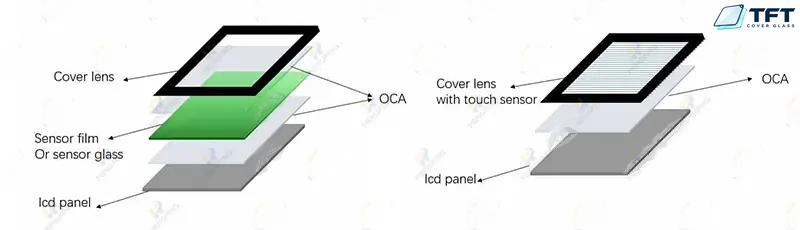
It is the final component that end users directly see and touch. Its core functions are:
- Protect the underlying display or sensor from impact, scratches, and daily wear;
- Deliver excellent optical performance (high transmittance in visible areas);
- Provide a premium, smooth touch feel with anti-fingerprint properties;
- Reduce glare and reflection through specialized surface treatments;
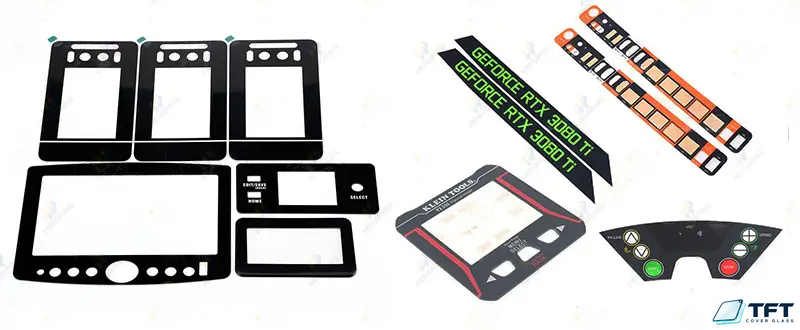
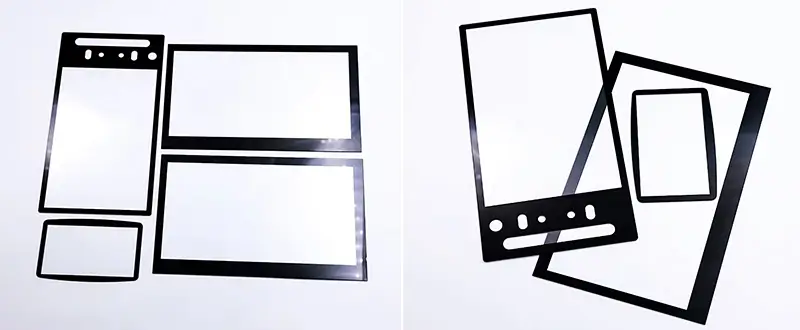
- Enhance overall device aesthetics via precise silk-screen printing, 2.5D/3D curved edges, and all-black (dead front printing) border designs;
Cover Lens Materials: Glass vs Plastic, Which One Should You Actually Choose?
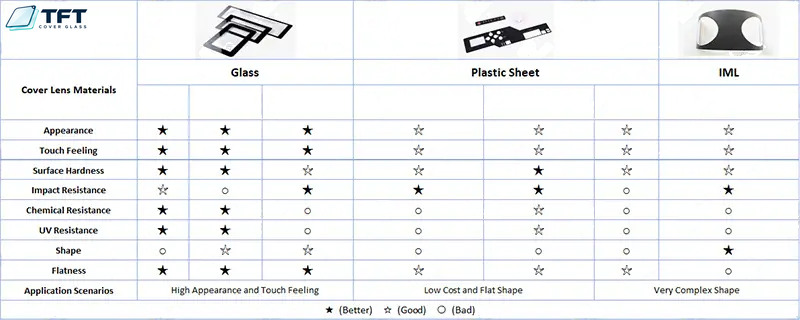
Cover lens materials are fundamentally divided into two main categories: plastic (PMMA, PC and their composites) and glass (soda-lime or aluminosilicate).
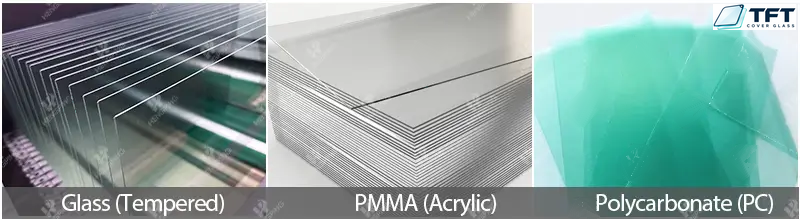
A few niche alternatives such as sapphire or ceramic-coated glass exist for special applications, but they represent only a tiny percentage of total volume and are almost never a direct substitute in standard projects.
Choosing the correct material category is the most important decision you will make when developing a new cover lens. The wrong choice leads directly to failed reliability tests, poor optical performance, or unacceptable user experience.
Below is the clearest, most practical breakdown used daily by professional sourcing and engineering teams, divided into two separate sections for easy comparison.
Plastic Cover Lens (PMMA/PC): Suitable for Budget-Oriented Applications
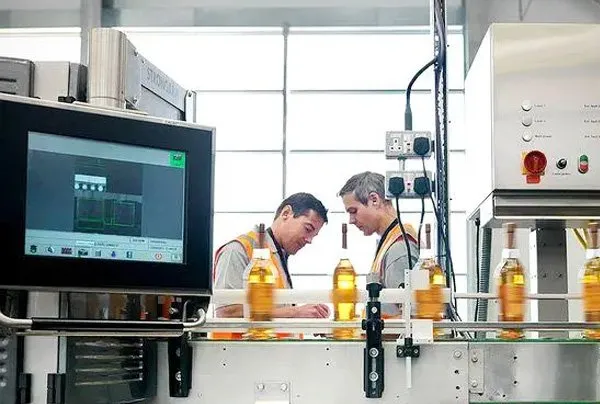
Plastic materials offer affordability and lightweight design but are limited by lower durability and optical performance compared to glass. They are commonly used in budget devices, industrial panels, and non-critical optical components where scratch resistance is secondary to cost.
| Sub-type | Process/Common Forms | Typical Applications | Key Advantages | Key Limitations |
| Injection Molded + IML | PC film, PC+PMMA film | LED lighting, entry-level feature phones, home appliances | Low cost, easy molding for complex shapes, shatter-resistant | Prone to birefringence (rainbow effects), yellowing under UV, hardness only 1–3H |
| Composite / Multi-layer Sheet | PC sheet, PMMA sheet, PMMA/PC sheet, PMMA/PC/PMMA sandwich | Rugged outdoor displays, industrial HMI panels, low-end wearables | Flexible for curved designs, lightweight (density ~1.2 g/cm³) | High water absorption changes refractive index, poor heat resistance (>80°C), not viable for high-volume consumer electronics |
Plastic cover lenses, mainly PMMA cover lens and Polycarbonate cover lens, currently account for roughly 20–25% of global volume. They are the preferred solution wherever cost, light weight, or complex 3D shaping is more important than long-term scratch resistance and optical clarity.
Glass Cover Lens: The Standard Choice for All Mid-to-High-End Devices
Glass remains the go-to material for 75–80% of cover lenses in consumer electronics, medical and industrial sector, offering unmatched clarity, strength, and customization. It is subdivided into two main types based on chemical composition, with aluminosilicate glass dominating premium applications.
| Glass Type | Chemical Composition Highlights | Al₂O₃ Content | Typical Strength After Chemical Strengthening | Main Applications |
| Soda-lime Glass | Na₂O-CaO-SiO₂ base system | < 6% (usually 1–4%) | CS ≈ 650–750 MPa, DOL 30–50 μm | Entry-level phone camera windows, cost-sensitive automotive HUDs, industrial displays |
| High-Aluminosilicate Glass | Elevated aluminum and alkali metals (e.g., Corning Gorilla Glass, Panda Glass, NEG, Schott Xensation) | ≥ 6% (usually 10–20%) | CS 800–1100 MPa, DOL 50–100 μm, pencil hardness 8–9H | Flagship smartphones (e.g., iPhone 17, Galaxy S26), foldable UTG, high-end camera modules, automotive center consoles |
Key physical properties comparison:
| Property | Soda-Lime Glass | High-Aluminosilicate Glass |
| Density | 2.39 g/cm³ | 2.45–2.50 g/cm³ |
| Young’s Modulus | ~70 GPa | 75–82 GPa |
| Vickers Hardness (un-strengthened) | ~530–550 kgf/mm² | ~600–680 kgf/mm² |
| Fracture Toughness | ~0.7 MPa·m⁰·⁵ | ~0.85 MPa·m⁰·⁵ |
| Coefficient of Thermal Expansion | ~8.5–9.0 × 10⁻⁶/°C | ~7.5–8.0 × 10⁻⁶/°C |
High-aluminosilicate glass leads the market due to its superior ion-exchange capabilities, enabling thinner profiles (down to 0.03 mm UTG for foldables) while surviving 1.5-meter drops. Soda-lime is reserved for secondary components where budget constraints outweigh peak performance needs.
Glass vs Plastic for Cover Lens
Surface Treatments & Coatings: AR vs AG vs AF vs Antimicrobial
In real projects, the four most commonly specified surface treatments on glass cover lens are AR (Anti-Reflective), AG (Anti-Glare), AF (Anti-Fingerprint) and Antimicrobial (Anti-Bacterial). These four surface treatments can be combined freely. Below is the exact explanation, measurement standards, key parameters and typical applications that procurement and optical engineers actually use.
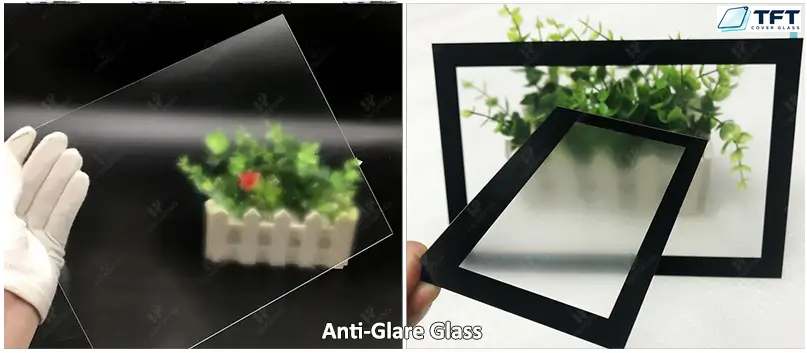
Anti-Glare (Etched or Coated) Treatment: AG Glass
AG treatment creates controlled micro-roughness on the glass surface through chemical etching or nano-coating, scattering reflected light and eliminating mirror-like reflections. (Read more: What is Anti-Glare Glass?)
Key measurement parameters
| Gloss Degree (60°) | Roughness Ra (nm) | Haze (%) | Transmittance (%) | Reflectance (%) | Typical Application Recommendation |
| 35 ± 10 | 0.18 – 0.22 | 17 | > 89% | ~8% | Heavy outdoor industrial panels, automotive centre consoles under direct sunlight |
| 50 ± 10 | 0.15 – 0.18 | 11 | > 89% | ~8% | Outdoor kiosks, marine displays, factory HMI |
| 70 ± 10 | 0.12 – 0.15 | 4.7 | > 89% | ~8% | Medical monitors, semi-outdoor devices |
| 95 ± 10 | 0.09 – 0.12 | 3 | > 89% | ~8% | Indoor high-end medical, indoor automotive |
| 110 ± 10 | 0.07 – 0.09 | 2 | > 89% | ~8% | Camera-module windows, indoor premium displays (minimal AG) |
Notes for buyers & engineers
- Lower gloss = stronger matte / anti-glare effect → ideal for outdoor industrial panels, automotive displays, medical monitors under strong lighting
- Higher gloss = closer to glossy mirror finish → preferred for indoor high-end medical displays or camera-module windows that need maximum clarity
- All values above can be further combined with AR, AF, antimicrobial and IR-cut coatings upon request.
Primary applications: Tablets, automotive displays, medical monitors, industrial panels used outdoors or under strong lighting
Anti-Reflective Coating: AR Glass
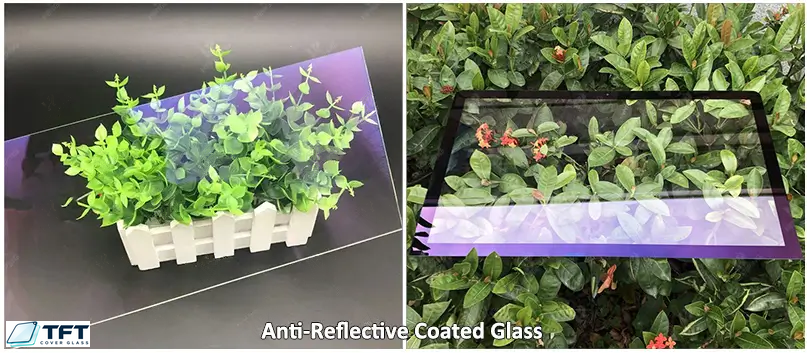
AR coating is a multi-layer vacuum-deposited coating (typically alternating high/low refractive index materials such as SiO₂ + TiO₂ or Nb₂O₅) that dramatically reduces surface reflection from approximately 4.2% (bare polished glass) down to ≤0.5% or even ≤0.2% across the visible spectrum.
Key benefits
- Greatly improves contrast ratio
- Enhances readability under strong ambient light
- Creates the deep “ink-black” premium appearance when the display is off
Key measurement parameters
| Coating Type | Thickness & Transmittance | Reflectance |
| Standard AR | 550 nm, >94% | <1.5% |
| Premium AR | 550 nm, >98% | <0.5% |
Notes for Buyers & Engineers
- Standard AR is ideal for industrial HMI panels and smart-home displays where cost-efficiency is key.
- Premium AR is mandatory for medical monitors, automotive HUDs, and camera modules requiring maximum outdoor readability and minimal glare.
- All coatings are multi-layer vacuum-deposited (4–8 layers) and fully compatible with AG, AF, and antimicrobial treatments.
Primary applications: Flagship smartphone cover lens, automotive centre consoles & HUD, high-end camera module windows, AR/VR optics
Anti-Fingerprint (Oleophobic) Coating: AF Glass
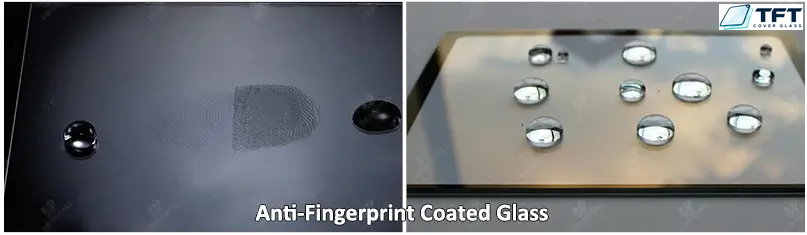
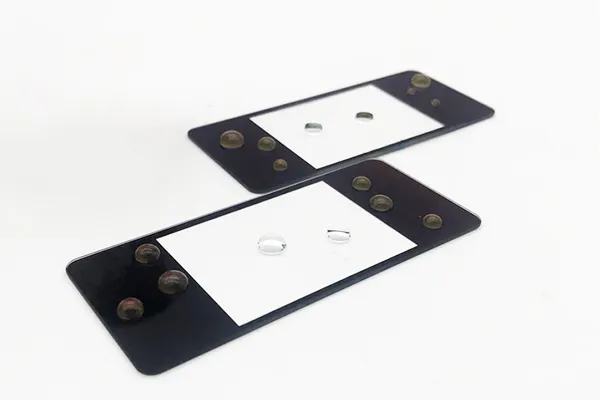
AF coating is an ultra-thin fluoropolymer layer (15–30 nm) that lowers surface energy so oil and fingerprints wipe off effortlessly.
Key measurement: Initial water contact angle ≥110° (premium ≥115°) After 10,000-cycle abrasion: still ≥100°.
Primary applications: Every smartphone, tablet, smartwatch, and in-car touch panel.
Antimicrobial (Anti-Bacterial) Coating: Antimicrobial Glass
Silver (Ag⁺) or copper (Cu⁺) ions are permanently implanted into the glass surface via ion-exchange. These ions disrupt bacterial cell walls on contact, achieving ≥99.9% kill rate with permanent effect.
Key performance (JIS Z 2801 / ISO 22196) Antibacterial activity R ≥ 3.0 → 99.9% reduction against E. coli, Staphylococcus aureus, MRSA, etc. Effectiveness lasts the lifetime of the glass
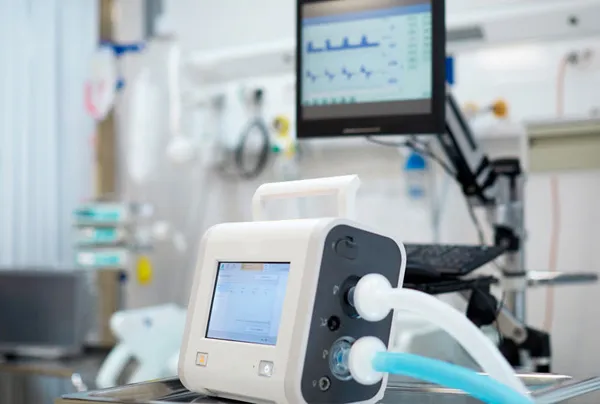
Primary applications: Medical equipment displays, public kiosks, elevator panels, shared education tablets, high-end smart home appliances
How Is a Glass Cover Lens Actually Manufactured?
Here is the exact production flow used daily by professional cover lens factories for industrial, medical, automotive, camera-module, and smart-home projects.
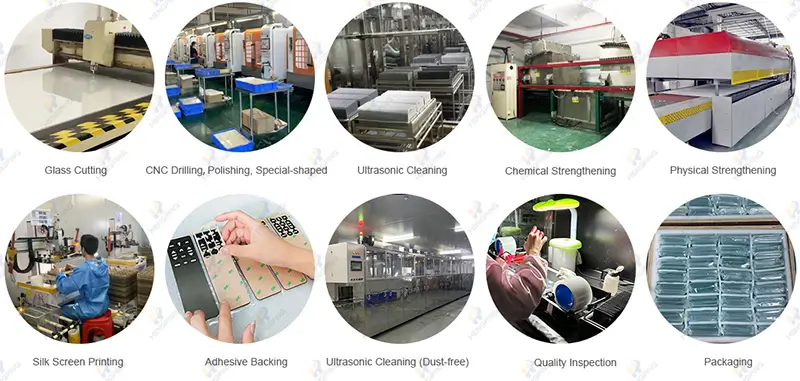
- Raw Glass Cutting
High-precision CNC machines with diamond wheels cut the original glass mother-sheet into required sizes. Thickness capability ranges from 0.1 mm to 5.0 mm, supporting square, round, and all irregular shapes with dimensional tolerance as tight as ±0.05 mm. - Double-Axis CNC Precision Machining
Dual-axis CNC stations perform edge chamfering (C-edge, R-edge, 2.5D/3D arcs), drilling, slotting, and complex contour shaping. Minimum achievable tolerance remains ±0.05 mm even on the most intricate designs. - Multi-Stage Ultrasonic Cleaning
Every single piece goes through a 10-tank ultra-pure water (18 MΩ) ultrasonic cleaning line to completely remove oil, particles, and chemical residues, creating a perfectly clean surface for the next processes. - Chemical Strengthening
Glass is preheated for 2 hours, immersed in 100 % pure KNO₃ molten salt for 4–12 hours at 400–450 °C, then cooled for another 4 hours.- Soda-lime glass achieves CS > 450 MPa, DOL > 8 μm
- High-aluminosilicate glass reaches CS > 650 MPa (often 800–1100 MPa), DOL > 40 μm and can pass IK08 impact rating.
- Physical Tempering (for thickness ≥ 2.0 mm, optional)
Thicker glass undergoes physical tempering so that, when broken, fragments within a 50×50 mm area exceed 40 pieces and all remain obtuse-angled, dramatically reducing injury risk. Smallest temperable size is 75×75 mm. - Silk-Screen Printing
Fully automatic printers (mainly using Japanese SEIKO ink) deliver up to 10-layer perfect registration. Special inks include high-temperature ceramic, IR-transmitting, metallic, and outdoor-grade UV-resistant ink that passes 1250-hour weathering tests without fading or peeling. - Ink Curing & High-Temperature Baking
Combination of flat-bed IR and precision ovens ensures the ink chemically bonds with the glass. Every piece must pass the 4B hundred-grid adhesion test. - Protective Film / Tape Lamination
In Class 1000 cleanrooms, double-sided tape, explosion-proof film, thermal-insulation film, or AB glue is applied with micron-level alignment, guaranteeing zero bubbles and perfect adhesion. - 100 % Final Inspection
Experienced inspectors (minimum 5 years) plus AQL 0.65 sampling check every piece for scratches, bubbles, colour deviation, edge chipping, and printing defects. Only perfect pieces move forward. - Cleanroom Packaging
Each piece receives double-side PE protective film, vacuum sealing, pearl-cotton cushioning, and is packed into high-strength cartons or wooden crates designed to survive long-distance international shipping without damage.
This fully vertical, tightly controlled process is what industrial, medical, automotive, and camera-module buyers demand. And it is exactly what we run every day at TFT Cover Glass for all non-smartphone glass cover lens projects.
Frequently Asked Questions About Cover Lens
1. Is “cover lens” exactly the same as “cover glass”?
Yes – in over 99% of technical drawings and purchasing documents they refer to the identical chemically strengthened glass component.
2. Can plastic (PMMA/PC) replace glass cover lens in smartphones?
Never for mid-range and above. Plastic fails drop tests, scratch resistance, and long-term optical clarity required by brands.
3. What is the difference between soda-lime and high-aluminosilicate glass?
High-aluminosilicate (Al₂O₃ ≥ 6%) achieves 800–1100 MPa strength and is used in all flagship devices. Soda-lime is limited to cost-sensitive secondary windows.
4. Which coating combination is most popular?
AR + AG (5–8% haze) + AF is the standard stack on current flagship phones and automotive displays.
5. How long does the antimicrobial effect last?
Permanent – the silver/copper ions are ion-exchanged into the glass surface, just like chemical strengthening.
6. Can cover lens be made completely opaque black?
Yes – the visible area remains transparent while borders are printed with high-density black IR-transmitting ink.
Conclusion
You now have the clearest, most practical guide to cover lens available anywhere: from the fundamental differences between glass and plastic, to the exact optical and coating specifications that industrial, medical, automotive, and camera-module projects actually demand. With this knowledge, you can confidently specify the right material, avoid common pitfalls, and select a supplier who truly understands your non-smartphone application needs.
At TFT Cover Glass, we specialize in high-performance glass cover lens for exactly these sectors and deliver consistent quality, full traceability, and fast response times that global Tier-1 projects rely on. Ready for samples, detailed test reports, or a customized quotation? Contact us today and let’s get your project moving.


 EN
 FR
 DE
 ES
 PT
 IT
 NL
 DA
 RU
 AR
 TR
 JA
 KO
 ID
 UK
 TH
 VI
 PL
 MS
 ET
 EL