In today‘s digital age, where screens dominate our daily lives, from smartphones and laptops to outdoor displays and automotive dashboards, glare from light sources can be a major nuisance. It reduces visibility, causes eye strain, and diminishes user experience. This is where anti-glare glass comes into play.
As a leading manufacturer of custom cover glass, we specialize in fabricating high-quality anti-glare (AG) glass tailored for various industries. In this comprehensive guide, we’ll explore what anti-glare glass is, how it’s made, its types, key parameters, and much more to help you make informed decisions for your projects.
What is Anti-Glare Glass?
Anti-glare glass, often abbreviated as AG glass, is a specialized type of glass designed to minimize reflections and glare caused by ambient light. Unlike standard glass, which acts like a mirror under bright conditions, AG glass scatters incoming light through a textured surface, reducing specular reflections while maintaining clarity and transparency.
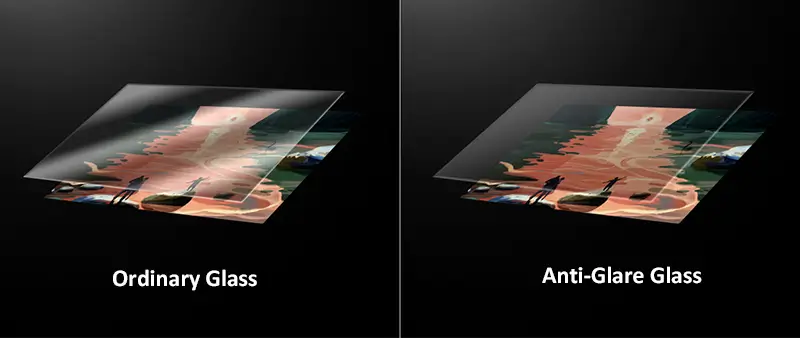
Anti-glare glass works by diffusing light rather than reflecting it directly back to the viewer. This diffusion is achieved through microscopic surface modifications that scatter light rays, lowering the gloss level and improving overall viewing comfort.
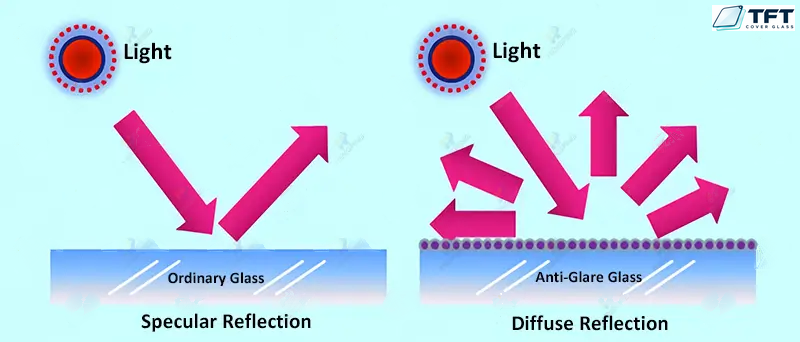
This technology enhances visibility in high-light environments, making it ideal for applications where readability is crucial. For instance, it prevents the “mirror effect” on screens, ensuring that users can see content clearly without distractions from overhead lights or sunlight.
At TFT Cover Glass, our AG glass solutions are customized to meet specific industry needs, providing superior optical performance and durability.
What Are the Key Parameters to Evaluate for Anti-Glare Glass?
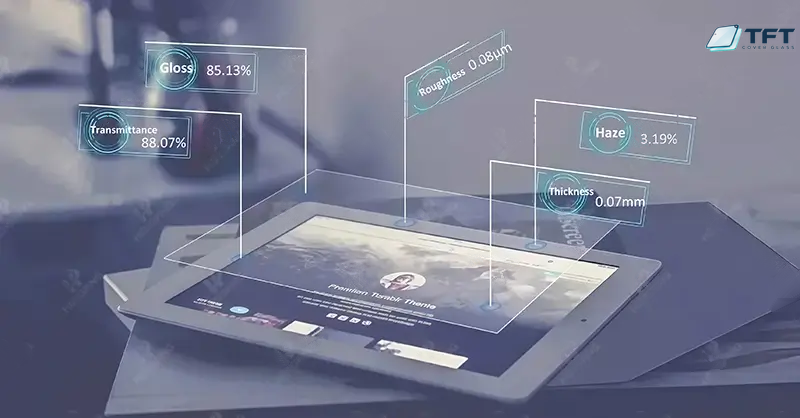
Evaluating anti-glare glass requires focusing on optical, physical, and surface characteristics. Gloss is the most critical parameter, directly determining the anti-glare effect. (Read more: 5 Key Parameters of Anti-Glare Glass: A Buyer’s Guide >>)
1. Optical Performance Parameters (Core of Anti-Glare)
Optical performance is at the heart of what makes anti-glare glass effective, as it directly influences how light interacts with the surface to reduce reflections and enhance visibility. These parameters ensure that the glass not only minimizes glare but also preserves image quality and brightness for optimal user experience.
1.1 Gloss
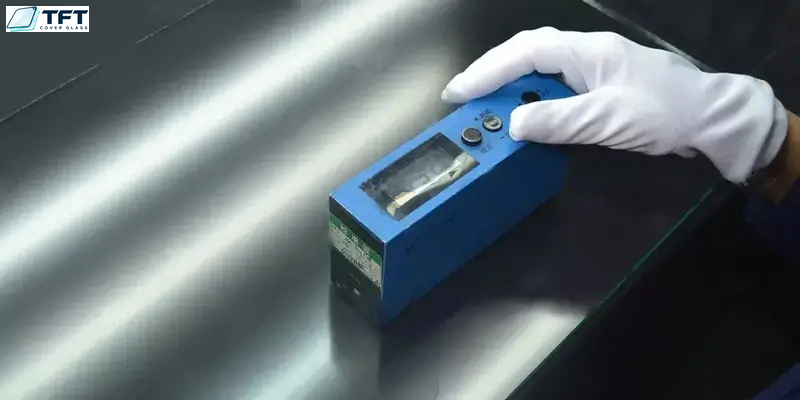
Measures how mirror-like the glass surface is. The lower the value, the rougher the surface, the stronger the diffuse reflection, and the better the anti-glare effect.
- Testing Standard:
Usually measured with a 60° gloss meter (e.g., WGG-60), testing 5 points and taking the average. Typical procurement specifications are 80±10 or 100±10, with incoming inspection tolerances of ±13 or ±15. - Industry Applications:
- Automotive: 110 (needs AR/AF coating)
- Indoor high-light environments (medical devices, POS machines): 95
- Outdoor environments (ATMs, advertising screens): ≤70
- Strong sunlight areas (e.g., Middle East): ≤50
- Touch panels (computer touch screens): ≤35
1.2 Transmittance
Proportion of visible light (380–700 nm) transmitted through the glass, affecting screen brightness.
Standard: ≥88% (etched AG glass may slightly decrease; spray-coated AG glass usually unaffected)
1.3 Haze
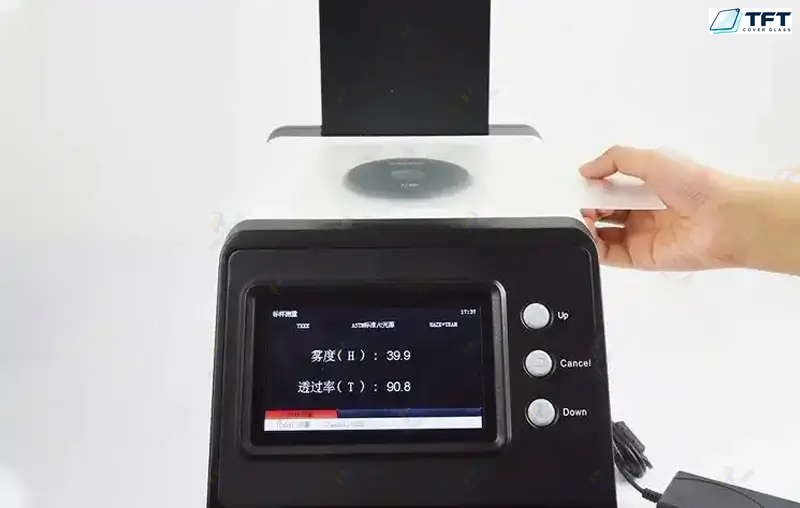
Proportion of scattered light deviating more than 2.5° from the incident light. Higher haze results in a blurrier image.
- Relationship: Inversely proportional to gloss (lower gloss → higher haze) and clarity (higher haze → lower clarity)
1.4 Clarity
Measures the ability of the glass to reproduce images. Calculated as: C% = (M – m) / (M + m) × 100%
where M and m are maximum and minimum light flux.
Key Point: Clarity is not directly related to haze or transmittance. Smaller particle size and narrower distribution lead to higher clarity.
2. Physical Specifications
Beyond optical properties, the physical specifications of anti-glare glass play a crucial role in its structural integrity, compatibility with devices, and overall durability in real-world applications. These parameters ensure the glass can withstand handling, installation, and environmental stresses without compromising performance. By assessing them, manufacturers and users can guarantee precise fit and long-term reliability for custom solutions.
2.1 Thickness
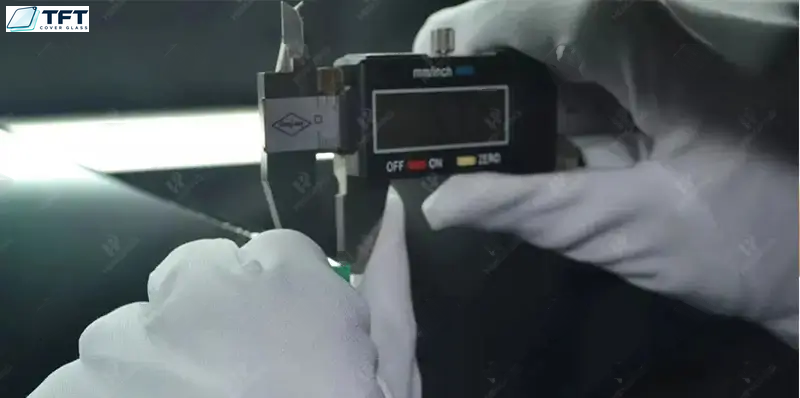
Distance between the upper and lower surfaces of the glass. Common range: 1.1 mm – 6 mm.
- Tolerance: Determined per customer sample. Generally ±0.2 mm; thickness variation within the same piece ≤0.2 mm (3 mm glass) or ≤0.3 mm (4 mm / 6 mm glass).
2.2 Dimension Tolerance
- Length/Width: ±0.5 mm
- Diagonal: difference between the two diagonals ≤0.2% of average diagonal length
2.3 Edge Quality
- Allowed chipping: length ≤3 mm, width ≤0.5 mm
- Cutting cracks and edge explosions are strictly prohibited
3. Surface Characteristics
Building on the physical foundation, surface characteristics delve into the microscopic details that directly influence the anti-glare functionality and tactile feel of the glass. These factors are essential for achieving consistent light diffusion and resistance to wear, making them key for high-precision evaluations. Understanding them helps in optimizing AG glass for specific uses, ensuring both aesthetic and functional excellence.
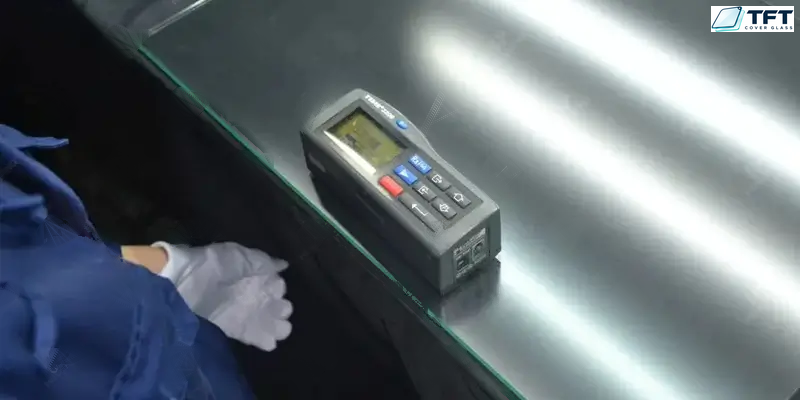
3.1 Roughness (Ra / Rz / Ry)
Micro-level unevenness of the surface, inversely related to gloss.
- Common Metric: Ra (arithmetical average deviation of the profile, μm); Rz can be included for high-precision applications
3.2 Particle Size Distribution
Diameter of surface particles after etching, measured under a microscope. More uniform particles lead to more stable anti-glare performance.
3.3 Sparkle Points (Bright Spots)
Local reflections caused by uneven surface particles. Fewer sparkle points occur with lower gloss.
4. Other Auxiliary Parameters
- Distinctness of Image (DOI): Sharpness of reflected images, related to particle distribution; smaller, more uniform particles yield higher DOI.
- Abrasion Resistance: Tested with 500 g weight + #0000 steel wool, 2000 strokes; gloss reduction ≤15%.
- Water Contact Angle: ≥105° (indicating anti-fingerprint performance)
When selecting AG glass, the gloss level should be determined first to match the intended application, then balanced with transmittance, haze, and surface roughness to optimize the anti-glare effect and image clarity
- Outdoor devices: prioritize low gloss (≤70)
- Automotive devices: require high gloss (≈110) combined with AR/AF coating technologies
How Is Anti-Glare Glass Made?
The production of anti-glare glass involves advanced surface treatment techniques to create a matte finish that combats glare. Common AG processes include spray coating AG, etching AG, sandblasting AG, plating AG (also known as coating AG), and film AG. However, spray coating AG and etching AG are the most primary and widely used methods due to their effectiveness and versatility. Each method has unique advantages, and the choice depends on the desired performance and application.
Etching Process
The etching method uses a chemical solution to create a uniform micro-texture on the glass surface. This microscopic roughness scatters light uniformly, effectively reducing glare and reflection while maintaining high transparency.
Key Features:
- Enduring Anti-Glare: Provides a stable and long-lasting anti-glare effect.
- Coating-Free: Exhibits strong resistance to wear, humidity, and chemicals due to the absence of a coating.
- Versatile Applications: Well-suited for use in outdoor displays and touch screens, industrial cover glass and appliance cover glass.
Typical Process Flow:
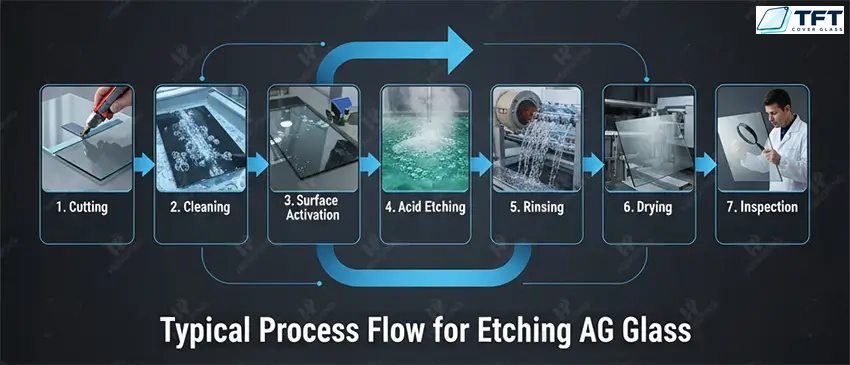
- Cutting: The glass is cut to the required dimensions.
- Cleaning: Surface contaminants are removed.
- Surface Activation: Prepares the glass for etching.
- Acid Etching: Chemical solution etches the surface to create texture.
- Rinsing: Removes residues.
- Drying: Ensures a clean finish.
- Inspection: Verifies quality.
Main Parameters:
- Surface Roughness (Ra): 0.02 – 0.10 μm
- Haze: 3% – 25%
- Light Transmittance: ≥ 90% (ultra-clear substrate)
- Gloss (60°): 10 – 70 GU
Spray Coating Process
The spray coating method applies a nano-material layer onto the glass surface using precision spraying technology. After curing, the coating forms a fine matte texture that diffuses light and minimizes reflection.
Key Features:
- Optical Customization: Flexible adjustment of optical properties is possible by controlling coating thickness and particle characteristics.
- Streamlined Manufacturing: Achieves high production efficiency and a consistently uniform surface.
- Optional Add-ons: Includes the potential for added functions like anti-fingerprint or easy-to-clean surfaces.
Typical Process Flow:
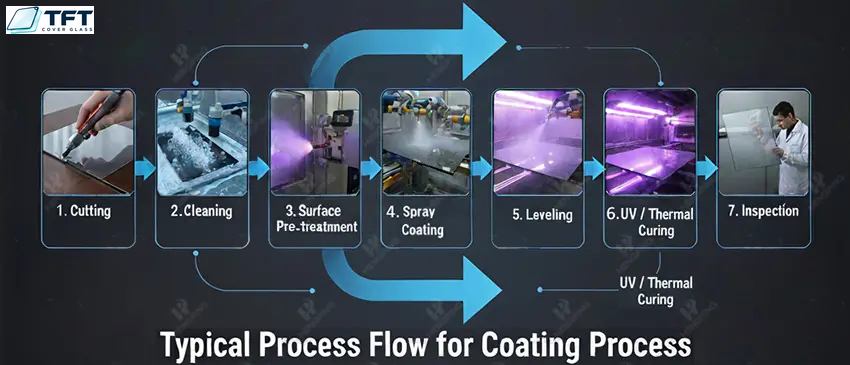
- Cutting: Glass is sized appropriately.
- Cleaning: Prepares the surface.
- Surface Pre-treatment: Enhances adhesion.
- Spray Coating: Applies the nano-material.
- Leveling: Ensures even distribution.
- UV/Thermal Curing: Hardens the coating.
- Inspection: Checks for defects.
Main Parameters:
- Coating Thickness: 3 – 10 μm
- Haze: 5% – 30%
- Transmittance: ≥ 88%
- Pencil Hardness: 3H – 9H
- Adhesion: Grade 0 – 1 (ASTM D3359)
- Chemical Resistance: ≥ 5 cycles (alcohol/alkali test)
At TFT Cover Glass, we employ both processes to deliver custom AG glass that meets stringent quality standards, ensuring optimal performance for your specific needs.
What Are the Types of Anti-Glare Glass and How Do You Choose the Right One?
Anti-glare glass can be categorized into several types based on the manufacturing process, including spray coating AG, etching AG, sandblasting AG, plating AG, and film AG. (Read more: Types of Anti-Glass Glass >>)
However, spray coating AG and etching AG are the most primary and widely used due to their effectiveness, versatility, and superior performance in most applications. The other methods, like sandblasting (which uses abrasive particles for texture), plating (depositing a thin film via vacuum or chemical means), and film (applying a pre-made anti-glare sheet), are less common but may suit niche requirements such as cost-sensitive or temporary solutions.
Main Types of Anti-Glare Glass
- Etched AG Glass: This type features a permanent textured surface created through chemical etching. It’s highly durable, resistant to wear, and maintains its properties over time without delamination risks. Best for harsh environments like outdoor displays or industrial applications.
- Spray-Coated AG Glass: Involves applying a thin coating layer that can be customized for additional features like anti-fingerprint. It’s more flexible in terms of optical properties but may require careful handling to avoid scratching the coating.
How to Choose the Right Type?
Selecting the appropriate AG glass involves considering your application’s environment, required durability, and optical needs:
- Environment: For outdoor or high-humidity settings, opt for etched glass due to its superior resistance.
- Functionality: If you need added features like anti-fingerprint, spray-coated is preferable.
- Gloss Level: Match to usage, lower gloss for bright sunlight, higher for indoor controlled lighting.
- Budget and Production: Spray coating offers efficiency for large volumes, while etching provides longevity.
Consult with experts like our team at TFT Cover Glass to customize based on your project specs.
How Is Anti-Glare Glass Inspected and Quality Tested?
AG glass requires strict quality control to ensure consistent optical and physical performance. At TFT Cover Glass, we adopt international testing standards for each production batch.
| Inspection Item | Testing Method | Standard/Reference | Purpose |
| Transmittance | Spectrophotometer | ASTM D1003 / GB/T 2410 | Evaluate light transmission |
| Haze | Haze Meter | ASTM D1003 | Assess anti-glare performance |
| Surface Roughness (Ra) | Optical Profiler / AFM | ISO 4287 | Ensure surface uniformity |
| Gloss (60°) | Gloss Meter | ASTM D523 | Check reflection control |
| Adhesion | Cross-cut Tape Test | ASTM D3359 | Evaluate coating adhesion |
| Hardness | Pencil Hardness Tester | ASTM D3363 | Measure surface durability |
| Chemical & Salt Spray Resistance | Immersion / Salt Spray Test | ASTM B117 | Verify environmental stability |
These tests guarantee that our AG glass meets or exceeds industry benchmarks, providing reliable solutions for your applications.
What Are the Applications and Case Studies of Anti-Glare Glass?
Anti-glare glass is versatile, finding use across multiple sectors where visibility and durability are key.

- Displays and Touch Panels: Used in monitors, tablets, and kiosks to reduce glare in office or retail settings.
- Automotive: Dashboards and infotainment systems benefit from high-gloss AG glass with AR/AF coatings for safe driving.
- Outdoor Equipment: ATMs, advertising screens, and solar panels in sunny regions like the Middle East use low-gloss variants.
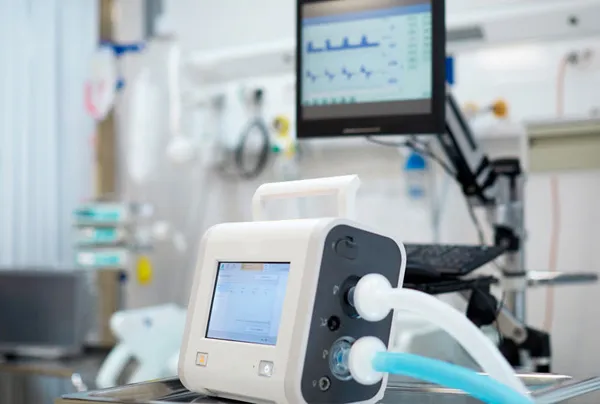
- Medical Devices: Ensures clear visibility on monitors in brightly lit hospitals.
- Appliance Cover Glass: For refrigerators or ovens, providing a premium, glare-free finish.
Case Study 1: Outdoor Advertising Screens
A client in the Middle East required AG glass for digital billboards exposed to intense sunlight. We supplied etched AG glass with gloss ≤50, haze 20%, and transmittance ≥90%. The result: 30% improved visibility, reduced eye strain for viewers, and extended screen lifespan due to enhanced durability.
Case Study 2: Automotive Touch Panels
For a luxury car manufacturer, we provided spray-coated AG glass with gloss 110, combined with AF coating. This achieved pencil hardness of 9H and water contact angle ≥105°, leading to fingerprint-resistant surfaces and clearer navigation displays, enhancing driver safety.
How Do You Maintain and Clean Anti-Glare Glass?
Proper maintenance ensures the longevity of anti-glare glass. Follow these tips:
- Daily Cleaning: Use a soft microfiber cloth with mild soap solution or isopropyl alcohol. Avoid abrasive materials to prevent scratching.
- Avoid Harsh Chemicals: Steer clear of ammonia-based cleaners, which can degrade coatings.
- For Etched Glass: Simply wipe with a damp cloth; its inherent durability resists wear.
- For Spray-Coated: Handle gently; test abrasion resistance periodically.
- Storage: Keep in a dust-free environment to maintain optical clarity.
- Professional Care: For industrial applications, schedule regular inspections to check gloss and haze levels.
By adhering to these guidelines, your AG glass will retain its anti-glare properties for years.
FAQs
1. What is the difference between anti-glare and anti-reflective glass?
Anti-glare glass diffuses diffusive reflections to reduce glare in bright environments; anti-reflective glass reduces overall reflections to increase light transmission, often used in optics where high clarity and color fidelity are required. The two are distinct in mechanism and outcome, and are sometimes confused in casual conversations.
(Read more: AR Glass vs. AG Glass: Differences & Applications & Selection Guide >>)
2. Can anti-glare coatings affect color accuracy on displays?
Some diffusion coatings may introduce minor color shift; modern AG solutions strive to minimize color distortion while maintaining glare reduction; verify with device-specific tests or supplier data.
3. How does gloss level affect anti-glare performance?
Lower gloss means better anti-glare, ideal for bright areas. For example, ≤35 for touch screens.
4. Can anti-glare coatings be applied to any glass type?
Yes, anti-glare coatings can be applied to most types of glass, such as float glass, tempered glass, and laminated glass, provided the surface is properly prepared and compatible with the coating process. However, factors like the glass’s composition, thickness, and existing treatments may require pre-assessment to ensure adhesion and performance.
5. Is etched AG glass more durable than spray-coated?
Etched is more resistant to wear and chemicals since there’s no coating layer, making it suitable for demanding applications.
6. What testing standards do you use for quality?
We follow ASTM and ISO standards, including D1003 for haze and transmittance, ensuring top-tier performance.
Conclusion
Anti-glare glass is a game-changer for enhancing visibility and user comfort in glare-prone environments. From its manufacturing processes to key parameters like gloss and haze, understanding these elements helps in selecting the right solution.
At TFT Cover Glass, we provide expert custom cover glass solutions for industries worldwide. Whether you need etched or spray-coated AG glass, contact us today to discuss your requirements and elevate your products with superior cover glass solutions.


 EN
 FR
 DE
 ES
 PT
 IT
 NL
 DA
 RU
 AR
 TR
 JA
 KO
 ID
 UK
 TH
 VI
 PL
 MS
 ET
 EL