
This article explores the critical role of anti-reflective (AR) coatings in optimizing the performance of display cover glass panels across various industries.
Introduction
In today’s technologically driven world, clear and easily readable displays are paramount across numerous sectors. From industrial control panels operating in direct sunlight to sophisticated medical diagnostic equipment requiring precise detail visualization, the ability to maintain optimal display visibility under diverse conditions is crucial. Poor visibility, caused by excessive glare and reflections, not only compromises usability but can also impact safety and efficiency.
Anti-reflective (AR) coatings address these challenges directly, significantly improving the performance and user experience of displays across a broad spectrum of applications. As a leading provider of high-performance cover glass solutions, we leverage advanced AR coating technologies to deliver superior display performance, tailored to the unique needs of our clients in industrial, medical, electronics and other sectors. This article provides a detailed exploration of AR coating technology, including its working principle, processing techniques, the anti-reflective coating types, its benefits, and the crucial considerations involved in selecting the optimal solution for your specific application needs.
What is Anti-Reflective (AR) Coating on Cover Glass?
Anti-reflective (AR) coating is a specialized surface treatment applied to glass, most commonly on tempered glass, to significantly reduce its reflectivity. Unlike untreated glass, which reflects a considerable portion of incident light, AR coated glass is designed to minimize this reflection. This is achieved by applying a thin layer or multiple layers of specific materials to the glass surface. These materials are carefully chosen to manipulate the way light interacts with the glass, reducing the amount of light reflected and increasing the amount transmitted. The result is enhanced light transmittance, leading to clearer and brighter images.
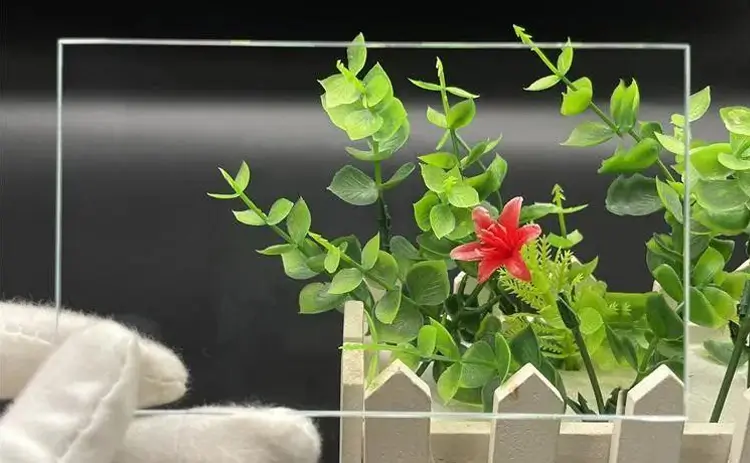
Furthermore, many AR coatings incorporate additional properties that enhance cleanability and increase the overall durability of the glass surface, offering resistance to scratching and extending the lifespan of the glass. The AR coating itself is therefore a key component in improving the optical and physical properties of the glass.
How Does Anti-Reflective (AR) Coating Work its Magic on a Glass?
Anti-reflective (AR) coatings on glass panels work by leveraging the principle of destructive interference of light waves. Thin layers of material with precisely controlled refractive indices and thicknesses are deposited onto the glass surface. When light strikes this layered structure, reflections from different interfaces interfere, effectively canceling out a significant portion of the reflected light.
For broadband AR coatings, multiple layers with varying properties are employed to achieve minimized reflection across a wide range of visible wavelengths. The careful selection of materials and precise control of layer thicknesses are critical to optimizing the anti-reflective performance, maximizing light transmission, and enhancing the clarity of the glass panel.
What is Process of AR Coating for Cover Glass?
In addition to the working principle, the core technology of AR coating also includes its preparation process. Currently, common AR coating preparation processes include spray coating, magnetron sputtering, vacuum evaporation coating, chemical coating and . Each of these processes has its own characteristics, but all of them need to precisely control the thickness and refractive index of the film to ensure the performance of AR coating.
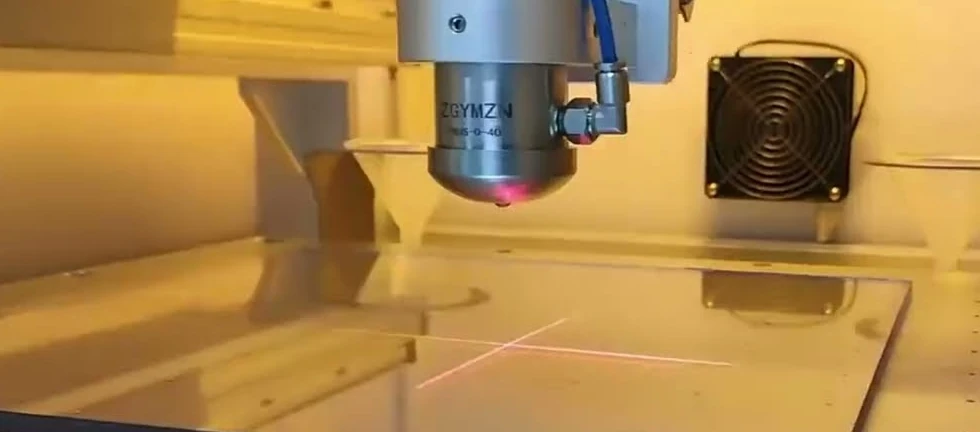
Spray Coating – Chemical
This solution-based method involves spraying a liquid AR coating precursor onto the glass surface. While relatively simple and cost-effective for low-volume applications, achieving uniform film thickness and consistent optical properties can be challenging.
Roll Coating – Chemical
A rotating roller applies a liquid AR coating solution to the glass. This technique offers improved uniformity and higher throughput compared to spray coating but may still exhibit variations in film thickness and optical properties compared to vacuum-based methods.
Dip Coating – Chemical
The glass substrate is immersed in a bath of AR coating solution and then withdrawn at a controlled rate. This method provides relatively uniform coating but may be limited in achieving precise thickness control and is less suitable for high-volume manufacturing.
Magnetron Sputtering Coating
This physical vapor deposition (PVD) method uses plasma to sputter target material onto the glass substrate, creating a thin, uniform AR coating. It provides excellent control over film thickness and optical properties, making it highly suitable for large-scale production of high-quality AR glass.
Vacuum Evaporation Coating
This PVD method involves heating a source material in a vacuum chamber. The vaporized material then deposits onto the glass substrate, forming a thin AR coating. Similar to sputtering, it provides good thickness control and optical quality but might have lower throughput compared to sputtering for certain materials.
Magnetron sputtering and vacuum evaporation are the most widely used processes in the cover glass panel industry due to their superior ability to produce high-quality, uniform AR coatings with precise control over optical properties and thickness, which are essential for high-performance display applications. The wet chemical methods (spray coating, roll coating, dip coating) are generally less precise and more prone to inconsistencies.
Are There Different Types of AR Coatings of Cover Glass Available?
There are different types of AR coatings based on their construction, performance, and application. Below are some types of AR coating for cover glass panels.
- Single-Layer AR Coating: This type of coating consists of just one thin layer, reducing reflections mainly through interference. It’s a good choice for applications where high reflection control isn’t critical, offering a cost-effective solution without compromising basic visual performance.
- Multi-Layer AR Coating: With several layers stacked on top of each other, multi-layer AR coatings provide superior performance by reducing reflections across a broader range of wavelengths. This makes them ideal for high-end applications where precise and effective anti-reflective properties are required, such as premium displays, optical instruments, and professional camera lenses.
- Low Reflection AR Coating: This coating reduces reflections to a decent level, making it suitable for general applications where reflection control is needed but not at an extreme level. It offers a balance between cost and performance and it is idea for industrial displays, advertising machines, and some consumer electronics like TVs and monitors.
- Super Low Reflection AR Coating: Designed to achieve ultra-low reflection rates (typically under 0.2%), this coating ensures a crystal-clear display with minimal glare. It’s perfect for high-visibility environments or precision applications where the highest visual clarity is crucial, like high-end displays, medical equipment, and professional-grade optical devices.
- Hard Coated AR Coating: This coating not only provides anti-reflective properties but also adds a layer of hardness, making the surface more resistant to scratches and wear. It’s perfect for applications that require durability alongside visual clarity, such as touchscreens, mobile phone displays, and industrial equipment.
- Nano AR Coating: By leveraging nanotechnology, this coating provides advanced reflection control while also offering additional benefits like self-cleaning, anti-fingerprint, and dirt resistance. It’s especially useful for surfaces that get frequent contact, such as high-end touchscreens, eyeglasses, automotive glass, and optical lenses.
- Anti-Fingerprint AR Coating: This coating combines anti-reflective properties with a layer that resists fingerprints and smudges. It’s designed to keep surfaces cleaner for longer, which is especially beneficial for high-touch devices, including smartphones, tablets, smart locks and other touch-sensitive devices.
Why AR Glass Isn’t Always Clear, Purple, Blue, or Green?
Have you ever noticed that AR coated glass isn’t always clear? Sometimes it exhibits a subtle tint, purple, blue or even green. This isn’t a defect, but rather a fascinating consequence of the physics governing how these coatings work.
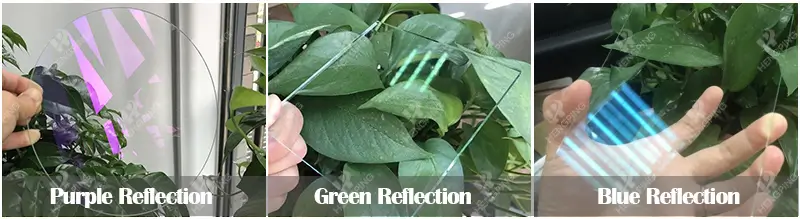
AR coatings achieve their anti-reflective properties through a phenomenon called thin-film interference. Multiple layers of precisely controlled thickness and refractive index are deposited onto the glass. When light hits this layered structure, reflections from each interface interfere with each other. For certain wavelengths, this interference is destructive, meaning the reflected light waves cancel each other out, resulting in increased light transmission. However, for other wavelengths, the interference can be constructive, leading to enhanced reflection.
The color you see is a direct result of this wavelength-dependent interference. If the coating reflects more blue light, it appears blue; more red and green light results in a purple hue; and more green light yields a green tint. The specific color is therefore a byproduct of the meticulous design and optimization of the coating layers to minimize reflection across the visible spectrum. It’s not a defect, but rather a testament to the precise control needed to achieve optimal anti-reflective performance.
In essence, the color is an indicator of the complex interplay of light waves within the AR coating’s multi-layer structure. It reflects the successful engineering of a sophisticated optical solution to achieve enhanced display clarity.
What are the Key Benefits of Anti-Reflective Coating for Cover Glass?
The integration of AR coatings into cover glass dramatically enhances display performance across a range of sectors:
- Enhanced Visibility and Readability: By reducing glare and reflections, AR coatings significantly improve the clarity and readability of displays, particularly in bright ambient light conditions. This is crucial for applications where clear visibility is critical, such as outdoor displays, industrial control panels, and medical equipment.
- Improved Light Transmission: AR coatings allow more light to pass through the cover glass, resulting in brighter displays and potentially reduced power consumption (especially important for battery-powered devices).
- Increased Durability and Scratch Resistance: Many AR coatings incorporate materials that enhance the scratch and abrasion resistance of the cover glass, extending its lifespan and maintaining its optical clarity over time.
- Enhanced Contrast: Reduced reflection leads to increased contrast, making displayed information easier to discern, particularly in challenging lighting environments.
- Reduced Eye Strain: The improved visibility and reduced glare provided by AR coatings contribute to reduced eye strain and fatigue, particularly during prolonged use.
- Improved Aesthetics: The reduction of reflections can result in a more aesthetically pleasing display, particularly with glossy surfaces.
Why Does AR-coated Glass Panels Need an AF Coating?
The surface of cover glass panels with AR (anti-reflective) coatings almost always incorporates an additional AF (anti-fingerprint) coating. This is not simply a matter of preference. It is a critical design choice driven by the operational realities of AR coatings and the need for long-term performance. (Read more: Identifying AG, AR & AF Glass: A Quick Guide for Glass Professionals >>)
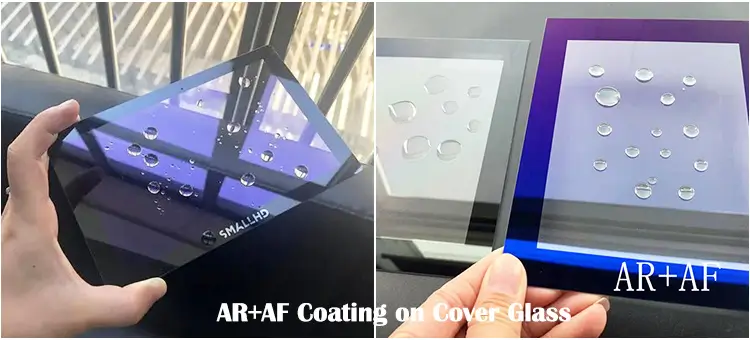
AR coatings, designed to minimize light reflection and enhance display visibility, are typically applied to the front surface of the glass panel. But the surface of the cover glass is most exposed to the environment, which makes the AR coating particularly vulnerable to several forms of degradation:
- Soiling and Contamination: Dust, fingerprints, oil, and other contaminants readily accumulate on the front surface of a display. These contaminants scatter light, negating the anti-reflective properties of the AR coating and significantly diminishing its effectiveness. A thick layer of accumulated dirt can effectively turn an anti-reflective coating into a highly reflective one, defeating its purpose.
- Scratching and Abrasion: The front surface of a display panel is prone to scratching and abrasion from everyday use, cleaning, or accidental contact. Even microscopic scratches can disrupt the carefully engineered structure of the AR coating, compromising its ability to control light reflection and causing localized areas of increased glare. The accumulation of minor scratches can degrade the overall anti-reflective performance over time.
- Chemical Degradation: Depending on the specific application, the AR coating may be exposed to cleaning agents, chemicals, or other substances that can chemically react with and degrade the coating’s material, altering its optical properties and reducing its effectiveness.
Therefore, the AF coating acts as a crucial protective layer for the underlying AR coating, addressing these vulnerabilities:
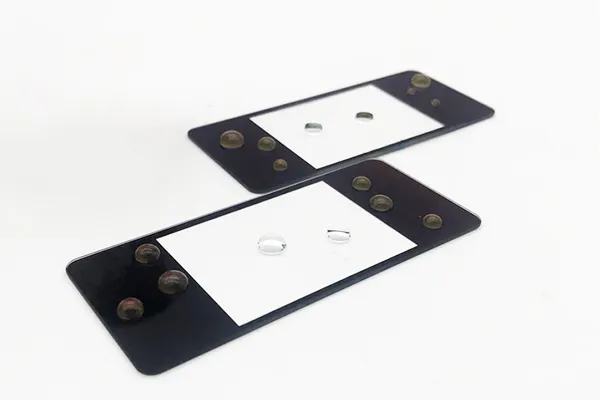
- Enhanced Resistance to Soiling: AF coatings typically possess oleophobic and hydrophobic properties, meaning they repel oil and water. This makes them significantly more resistant to fingerprint smudges and other forms of soiling, preserving the clarity of the AR coating. Cleaning is also typically easier, reducing the risk of scratching the AR layer during cleaning.
- Improved Scratch Resistance: AF coatings often incorporate materials that enhance the scratch resistance of the underlying AR coating, providing an additional barrier against abrasion and extending the lifespan of the AR functionality.
- Chemical Protection: Depending on the specific formulation, AF coatings can offer a measure of protection against chemical degradation, further safeguarding the AR coating from environmental influences.
For display cover glass panels, the integration of an AF coating isn’t merely an optional addition, but it’s a necessary measure to ensure the long-term effectiveness and durability of the AR coating. While an AF coating may add a small amount to the overall manufacturing cost, the benefits in terms of maintaining optimal display performance and extending the useful life of the product significantly outweigh the additional expense.
The inclusion of both AR coating and AR coatings is a common practice precisely because of their synergistic effect to maintain the AR coating’s performance over time and ensure that the display retains its clarity and readability throughout its operational lifespan. Importantly, a properly designed AF coating does not measurably affect the transmittance of the underlying AR coating.
Case Studies: Real-World Applications of Advanced AR Cover Glass
As a professional manufacturer of custom cover glass panels, we have accumulated rich experiences in the surface treatment of glass. Below are two real projects of AR coated glass.
Cover Glass Panels for Ovens (Home Appliances)
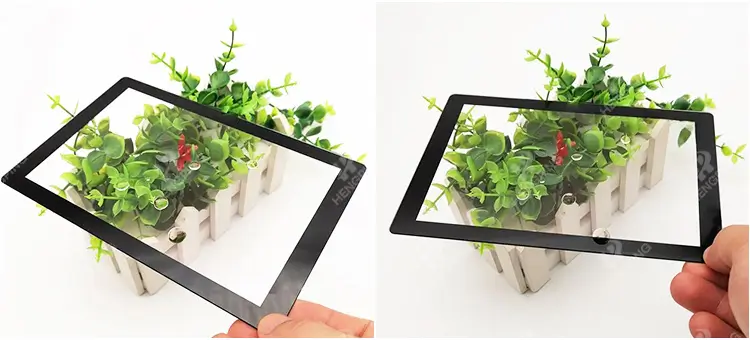
- Client Needs: The client experienced issues with their existing acrylic display panels, namely susceptibility to scratches and deformation over time. An upgrade to a more durable and reliable material was required.
- Solution: The client upgraded to a glass display panel utilizing Corning Gorilla Glass, a widely used and robust material.
- Specifications:
- Material: Corning Gorilla Glass
- Thickness: 1.1 mm (a standard thickness)
- Initial Transmittance: 92% (inherent to the Corning Gorilla Glass)
- Enhancements: Despite the high inherent transmittance of the Gorilla Glass, an additional AR (anti-reflective) and AF (anti-fingerprint) coating was applied to further enhance performance.
- Resulting Transmittance: The combined AR + AF coating increased the overall transmittance to 94%, improving visibility and clarity. The addition of the coatings also provides enhanced scratch and smudge resistance, further improving the longevity and aesthetics of the display.
- Client Requirements: The client, a manufacturer of marine navigation equipment, required custom anti-reflective (AR) coated glass panels for their displays. Their specifications were exceptionally demanding, pushing the boundaries of current AR coating technology. Key requirements included:
- Coating Method: Vacuum magnetron sputtering was specified as the only acceptable deposition method.
- Color Matching: The AR coating color needed to precisely match the client’s existing products (light blue), maintaining consistent color within a strict tolerance across all production batches.
- Surface Quality: Extremely high standards were set for surface quality, demanding minimal defects (pinholes, etc.).
- Optical Performance: A transmittance of >94% and a water contact angle of >110° were required.
- Durability: The coating needed to withstand rigorous abrasion testing (#0000 steel wool, 500g weight, 2500 cycles), maintaining a water contact angle >95°.
- Technical Challenges & Discussion: To fully understand the client’s needs and address potential challenges, a site visit was conducted to discuss the requirements in detail. Key points of discussion included:
- Magnetron Sputtering Complexity: Magnetron sputtering, unlike simpler methods like evaporation or spray coating, necessitates a three-chamber continuous process. For the specified 10-inch glass panels, each batch can only accommodate 77 pieces, resulting in significantly higher costs for both prototyping and mass production. Low-volume production becomes particularly challenging due to inefficient utilization of production line capacity.
- Color and Defect Control: Achieving the required color consistency and minimizing defects (pinholes, etc.) represents a significant technological hurdle. Current industry practices often rely heavily on post-production selection, leading to low yield rates and increased costs. The client’s tight color tolerance and stringent defect requirements push these challenges to their limits.
The client’s demands presented significant technical and economic challenges, requiring careful consideration of the trade-offs between cost, production efficiency, and the stringent quality standards specified.
What is the Right Approach to Choosing an AR Coating for Your Cover Glass Project?
Selecting the ideal AR coating for your cover glass project requires a careful evaluation of various factors to ensure optimal performance and longevity. A one-size-fits-all approach is rarely suitable, highlighting the need for a customized solution.
Key Considerations for AR Coating Selection
| Factor | Description | Importance |
| Operating Environment | Temperature range, humidity levels, exposure to chemicals, potential for physical impact or abrasion. | Determines the required durability and resistance of the AR coating to environmental factors. |
| Display Type | Resolution, backlight technology (LED, OLED, LCD), required color accuracy. | Affects the specific wavelength range for AR coating optimization. |
| Required Durability | Level of scratch resistance, abrasion resistance, and chemical resistance needed for the intended application. | Crucial for maintaining optical clarity and extending the lifespan of the display. |
| Wavelength Range | The specific wavelengths of light emitted by the display. | The AR coating needs to be optimized for the specific wavelengths to minimize reflection and maximize transmission. |
Our expertise lies in providing customized AR coating solutions precisely tailored to meet these specific requirements. We work closely with our clients to understand their unique application needs and recommend the optimal AR coating for superior performance.
Conclusion
Anti-reflective coatings are indispensable for maximizing the performance and usability of displays across a broad spectrum of applications. By enhancing visibility, reducing glare, and improving overall user experience, AR coatings contribute significantly to improved safety, efficiency, and user comfort. As a leading provider of customized AR-coated cover glass solutions, we are committed to providing our clients with superior products tailored to meet their exact needs. Contact us today to discuss your specific display requirements and explore how our advanced AR coating technology can elevate the performance of your systems.


 EN
 FR
 DE
 ES
 PT
 IT
 NL
 DA
 RU
 AR
 TR
 JA
 KO
 ID
 UK
 TH
 VI
 PL
 MS
 ET
 EL