
Introduction
Glass drilling for cover glass manufacturing represents one of the most technically demanding precision manufacturing processes in modern industry. Achieving tolerances of ±0.001 inches while maintaining chip-free edges requires mastery of specialized equipment, advanced tooling strategies, and rigorous quality control systems. This comprehensive technical guide synthesizes cutting-edge manufacturing techniques, industry standards, and optimization strategies essential for manufacturers in various industries and design engineers specifying cover glass requirements across industrial displays, medical devices, smart home interfaces, and interactive kiosks.
The growing demand for precision cover glass in applications ranging from EV charging stations to medical diagnostic equipment has pushed manufacturing capabilities to new limits. Modern glass drilling operations must balance multiple competing requirements: achieving micrometer-level accuracy, maintaining optical clarity, ensuring structural integrity, and optimizing production economics. Success requires understanding fundamental glass behavior, selecting appropriate equipment and tooling, implementing comprehensive quality systems, and continuously optimizing manufacturing processes.
Fundamental Glass Drilling Principles
Material Properties and Glass Types
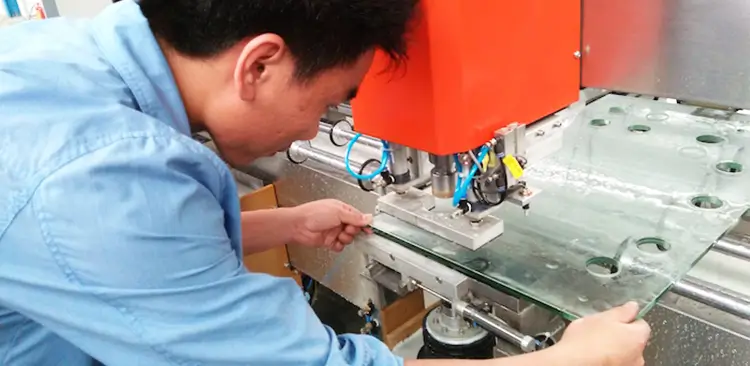
Glass presents unique challenges as a manufacturing material due to its brittle nature, thermal sensitivity, and varying chemical compositions. The three primary glass types used in cover glass applications each demand distinct processing approaches:
- Soda-lime Glass: Most economical and easiest to machine, providing adequate performance for basic industrial controls
- Aluminosilicate Glass: Superior strength-to-weight ratios essential for smartphone screens and high-performance displays, though requiring precise machining control to maintain structural integrity
- Borosilicate Glass: Exceptional thermal shock resistance for demanding environments requiring temperature stability
Understanding the relationship between glass composition and drilling behavior proves critical for parameter optimization. In most cases, glass must be drilled first, then strengthened (tempered), as post-strengthening drilling will cause the glass to shatter due to the disruption of internal stress balance.
Core Drilling Parameters
Core drilling principles center on managing thermal stress while achieving precise dimensional control. High spindle speeds of 500-5,000 RPM combined with low feed rates of 0.001-0.005 mm/rev minimize thermal stress and prevent crack propagation. Continuous coolant flow using deionized water prevents overheating while removing debris, while progressive entry techniques starting at 45-degree angles create positioning grooves before transitioning to vertical drilling.
For holes exceeding three diameters in depth, peck drilling cycles prove essential for evacuating chips and maintaining coolant circulation. The relationship between glass thickness and processing parameters requires careful calibration. Thin glass substrates below 2mm demand higher speeds with minimal feed pressure to prevent flexural stress, while thick glass exceeding 6mm requires reduced speeds with increased coolant flow to manage heat buildup.
Critical Hole Diameter Rule
One of the most fundamental rules in glass drilling involves the relationship between hole diameter and glass thickness. The hole diameter must be at least equal to the glass thickness, and preferably three times the thickness for optimal results. This rule becomes critical when glass undergoes thermal tempering.
When drilling size is less than 3 times of the glass thickness or the aperture is less than the thickness of the glass, the compressive stress (CS) of the hole cannot be evenly dispersed while the CS around the hole becomes quite concentrated during cooling in thermal tempering. This results in very low yield rates when drilling size is smaller than glass thickness during tempering, as the glass will easily crack during the tempering process.
For thermal tempered glass, which achieves compressive stress of 90-140 MPa through rapid cooling after heating to near the softening point, this diameter rule ensures stress distribution remains manageable during the tempering process. Violating this rule leads to stress concentration points that compromise structural integrity and manufacturing yield rates.
Precision Hole Requirements
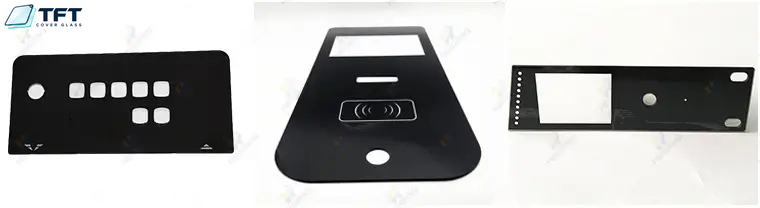
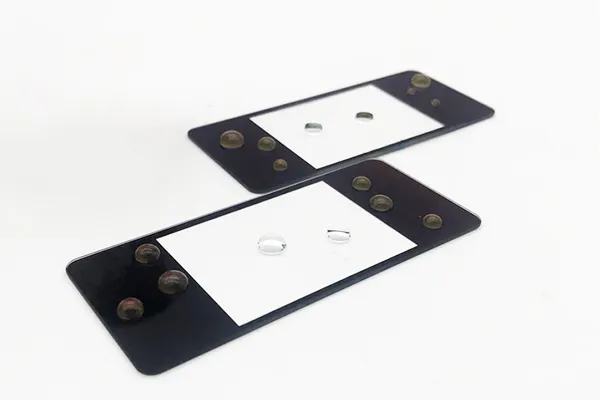
Some cover glass applications require precision drilling to accommodate other components, such as camera holes, sensor holes, and even complex hole-in-hole structures. The size and positional accuracy of these holes directly affects product functionality, demanding high-precision CNC control and accurate tooling. In glass processing, terms like “multi-hole,” “irregular holes,” and “screw holes” were once keywords that many processors avoided, with “this cannot be done” becoming a standard industry response.
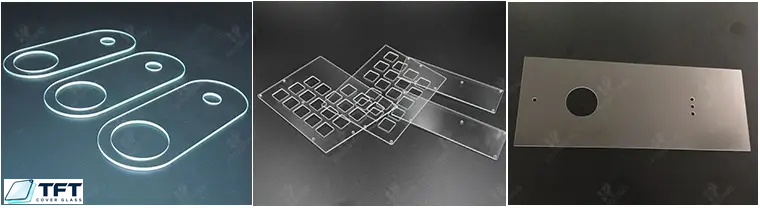
Looking back to 2013, when we first faced glass requiring 16 precision holes, we experienced a long technical struggle involving CNC drilling and manual precision grinding, with each step requiring extreme caution. Any carelessness during the final hole could result in edge chipping, rendering the entire glass panel unusable. After a month of repeated trial and error, we barely managed to deliver samples. The yield rate, efficiency, and costs at that time made “multi-hole glass” a persistent shadow in our minds.
Today, when facing high-difficulty drilling requirements, we no longer have any hesitation. Those multi-hole arrays, irregular hole positions, and precision screw holes that were once regarded as “process forbidden zones” have now become the best proof of our technical strength. Every piece of precisely processed multi-hole glass carries the transformation journey from “fear” to “conquest.”
Equipment and Tooling Requirements
CNC Machining Centers
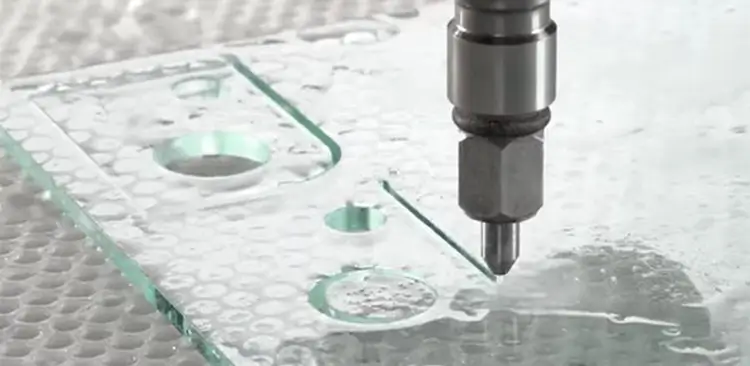
Modern cover glass manufacturing demands specialized CNC machining centers designed specifically for glass processing challenges. Air-bearing spindles minimize vibration and subsurface micro-cracking while achieving spindle run-out below 2 micrometers. Five-axis interpolation capability enables complex bevels and aspheric surfaces, while flood coolant systems with deionized water prevent staining and maintain consistent processing temperatures.
Leading manufacturers provide comprehensive solutions tailored to different production requirements. Intermac’s Master Series offers configurations from compact Master 23 units handling 2.6m x 5m glass sheets to unlimited-capacity Master 63-65 systems for high-volume production. These centers feature 18-28 position tool magazines with 10-second automatic tool changes and integrated Helix drilling systems capable of boring, grinding, and countersinking operations on glass up to 19mm thick.
Vacuum work-holding systems represent a critical component often overlooked in equipment selection. Multi-zone vacuum control accommodates various glass sizes while pneumatic clamping systems provide secure holding without inducing stress concentrations. Positioning accuracy of ±5 micrometers becomes achievable with proper setup, enabling the tight tolerances required for modern display applications.
Diamond Tooling Systems
Diamond tooling represents the foundation of precision glass drilling, with tool selection directly impacting edge quality, dimensional accuracy, and production economics. Monocrystalline diamond tools deliver mirror-quality finishes below 0.05 micrometers Ra, making them essential for optical applications where surface quality affects light transmission. Polycrystalline diamond (PCD) tools offer economical alternatives for roughing operations, while chemical vapor deposited (CVD) diamond grades provide balanced performance with tool life extensions of 12-20 times over carbide alternatives.
Diamond core drill specifications must align with specific application requirements, ranging from 0.3mm to 48mm diameter to accommodate everything from sensor holes to large mounting features. Sintered metal bond diamond drills provide consistency and precision essential for cover glass applications, while continuous rim designs ensure chip-free cutting. Multi-layered electroplated diamond core drills feature three diamond layers for extended service life, critical for high-volume production environments.
Tool life optimization requires understanding the relationship between diamond grit size, bond strength, and cutting parameters. Advanced tool management systems track individual tool performance, automatically compensate for wear, and predict replacement intervals. This data-driven approach reduces tool costs by 15-20% while maintaining consistent quality.
Quality Control and Manufacturing Standards
Industry Standards Framework
Quality control in glass drilling extends far beyond simple dimensional verification to encompass edge quality, subsurface damage assessment, and application-specific performance requirements. ASTM C1036 establishes fundamental quality requirements for flat glass, defining acceptable defect limits based on glass size with specific criteria for scratches, bubbles, and surface imperfections. For glass exceeding 35 square feet, maximum three scratches up to one inch long represent acceptable quality levels.
Industrial standards vary significantly across applications. Medical equipment requires FDA compliance for patient-contact applications with biocompatibility per ISO 10993 standards. Industrial displays demand IK10 impact ratings for harsh environments, while smart home applications prioritize aesthetic requirements with minimal visible defects. The universal 10-foot inspection rule limits defect evaluation to what’s visible from 10 feet under daylight conditions, focusing on the central 80% of glass area.
Chipping Control and Prevention
Chipping, known as 崩边 in Chinese manufacturing contexts, represents the most common defect in glass drilling operations. Quantified using chip radial distance (CRD) and chip thickness (tc) measurements, chipping can be controlled to 0.25-0.4 microns with advanced laser systems compared to 10-50 microns typical of mechanical drilling. Prevention strategies focus on proper drill bit selection, optimized feed rates, and continuous cooling, while two-sided drilling techniques reduce exit chipping by approaching from both surfaces.
Advanced inspection technologies enable comprehensive quality assessment beyond visual inspection. Coordinate measuring machines (CMM) provide precise chipping volume quantification, while optical scanning systems automate defect detection and classification. Statistical process control implementation enables real-time quality monitoring with automatic process adjustment based on trending analysis.
Manufacturing Technologies Comparison
Mechanical vs. Laser Drilling Systems
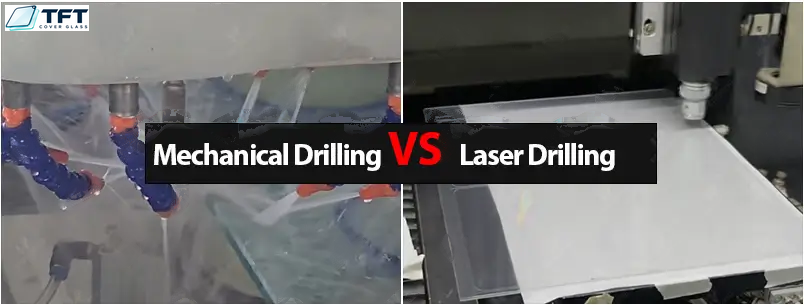
The evolution from mechanical to laser drilling represents a fundamental shift in glass processing capabilities, driven by demands for higher precision, reduced thermal impact, and increased geometrical flexibility. Traditional mechanical drilling remains viable for many applications with lower initial equipment costs (50-70% less than laser systems) and established process knowledge. However, limitations include tool wear, edge chipping typically 10-50 microns, and geometric restrictions to circular holes.
Ultrafast laser systems achieve tolerances to ±0.01mm while eliminating tool wear, contamination, and mechanical stress on glass substrates. Edge chipping reduces to 0.25-0.4 microns compared to mechanical methods, while capability extends to complex geometries including rectangular, square, and irregular shapes without tool changes. Femtosecond laser processing enables cold ablation without thermal effects through multi-photon absorption and cascade ionization.
Cost analysis reveals laser systems require higher initial investment ($200K-$2M+ depending on specifications) but deliver lower long-term operating costs through eliminated consumable tools and reduced maintenance. Higher production rates and reduced reject rates offset initial investment for volume applications, while the ability to process complex geometries without secondary operations provides additional economic benefits.
Advanced Laser Technologies
Hybrid ultrafast techniques push performance boundaries further. Bessel beam technology enables through-hole drilling in microseconds regardless of thickness, while coaxial dual-laser systems combining femtosecond pulses with fiber lasers achieve over 5000x speed improvements. TSL (Transient Selective Laser) technology enables ultrahigh-speed drilling via transient electronic excitation, achieving rates exceeding 20,000 holes per hour for specialized applications.
Application-Specific Requirements
Industrial Equipment Applications
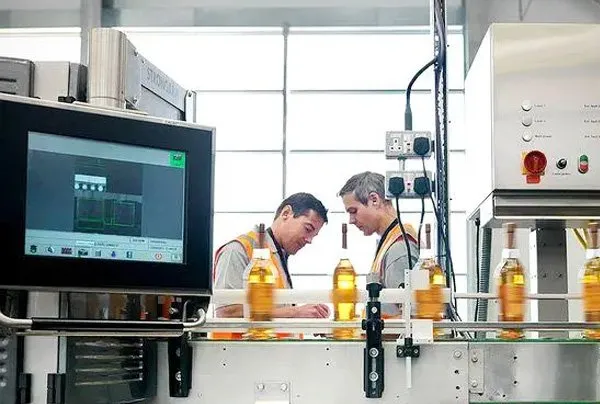
Industrial equipment displays require environmental protection with IP65/67 sealing and temperature performance from -20°C to +60°C, demanding precise hole positioning for gasket interfaces and mounting hardware. EMI compliance necessitates careful consideration of hole patterns that might compromise shielding effectiveness. Vibration resistance and thermal management considerations affect drilling location selection and structural integrity requirements.
Medical Device Manufacturing
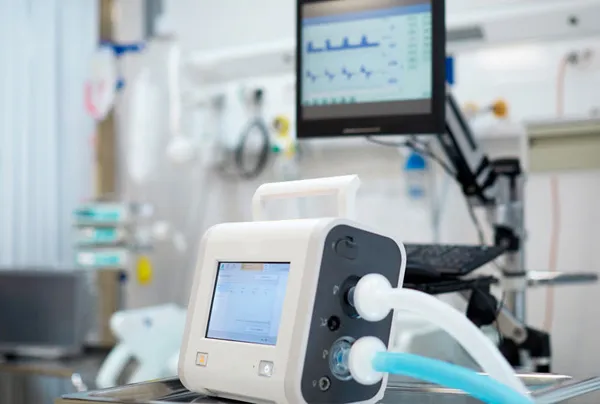
Medical device panels present the most stringent requirements with biocompatibility per ISO 10993 standards for patient-contact applications. Sterilization compatibility across gamma, ETO, and steam cycles requires material selection and drilling techniques that preserve glass integrity under extreme conditions. Antimicrobial surface treatments must maintain effectiveness despite drilling operations, often requiring specialized post-processing steps and complete documentation traceability for regulatory compliance.
Consumer Electronics Integration
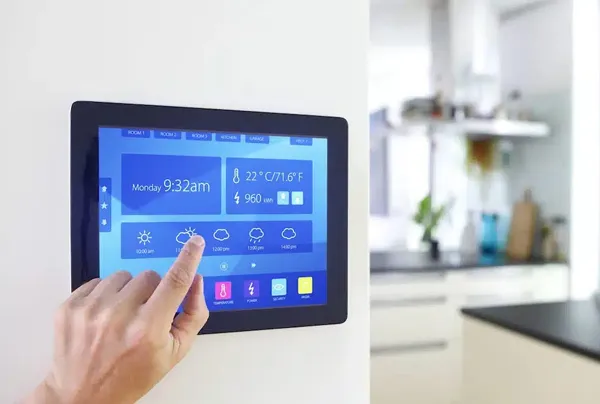
Smart home interfaces emphasize aesthetic integration with minimal bezels and seamless design elements. Proximity sensing capabilities demand precise hole positioning for sensor alignment, while wireless performance compatibility requires understanding electromagnetic effects of hole patterns on Wi-Fi, Zigbee, and BLE operation. Battery-powered operation imposes strict power consumption limits affecting display backlighting and heating elements, influencing drilling pattern optimization for thermal management.
Manufacturing Optimization Strategies
Cost Control and Production Efficiency
Production optimization in cover glass manufacturing requires systematic analysis of material costs, energy consumption, equipment utilization, and quality yield rates. Glass type selection based on volume economics reveals soda-lime glass offers 50-150% cost advantages over aluminosilicate for applications where premium performance isn’t required. Volume effects become significant with mold costs of $1,680 distributing to $0.34 per unit at 5,000-piece production runs.
Energy efficiency represents 14% of total production costs in glass manufacturing, with improvement potential of 20-25% achievable through process optimization. Advanced Process Control (APC) implementation with machine learning algorithms enables real-time parameter adjustment based on material feedback and environmental conditions. Equipment utilization optimization requires Advanced Planning and Scheduling (APS) systems for dynamic capacity management with real-time adjustment for equipment availability and personnel changes.
Quality Optimization Through Technology
Through over 10 years of deep cultivation, we have completely rewritten the processing logic of drilled glass through continuous technological iteration. From the initial 16 holes to the current stable mass production of 18 holes, 30 holes, and even larger apertures and more complex arrangements, we have established a complete precision processing system. By optimizing tool paths and introducing high-precision laser equipment, we have not only controlled the edge chipping rate to extremely low levels but also improved processing efficiency to industrial mass production standards.
100% visual inspection with AQL sampling protocols ensures consistent quality while managing inspection costs. Material traceability systems enable rapid quality issue resolution while supporting continuous improvement initiatives. The embarrassing situation of “one month to make one piece” has been replaced by the confidence of “efficient delivery.”
Emerging Technologies and Future Directions
Industry 4.0 Integration
The integration of Industry 4.0 technologies with traditional glass manufacturing creates opportunities for unprecedented precision and efficiency improvements. Machine learning algorithms optimize drilling parameters in real-time based on material feedback, tool wear, and environmental conditions, enabling adaptive manufacturing that continuously improves quality and productivity. Digital twin technology allows virtual process optimization before physical implementation, reducing development time and costs.
Robotic integration extends beyond simple material handling to include vision-guided positioning, real-time quality control, and adaptive force control during processing. Six-axis articulated robots with ±0.1mm repeatability enable complex part manipulation while integrated vision systems provide automatic positioning correction.
Future Manufacturing Technologies
Advanced drilling technologies continue evolving with quantum processing development promising next-generation ultrafast laser capabilities. Hybrid systems combining multiple drilling technologies in single platforms offer solutions for specialized requirements while AI integration enables predictive quality control based on process parameters. The convergence of 5G/6G device requirements, AR/VR display development, automotive smart glass integration, and IoT device miniaturization creates new challenges and opportunities for increased hole density requirements and complex optical integration needs.
Sustainability initiatives including recycled glass integration and circular economy principles drive innovation in manufacturing process design, while premium market segments develop for specialized capabilities addressing next-generation device requirements.
Conclusion
Advanced cover glass drilling manufacturing requires mastery of complex interactions between materials science, precision machining, quality control systems, and production optimization strategies. Success depends on understanding fundamental glass behavior, selecting appropriate equipment and tooling combinations, implementing comprehensive quality management systems, and continuously optimizing manufacturing processes for efficiency and cost effectiveness.
Companies implementing integrated approaches combining advanced drilling technologies, optimized workflows, and data-driven decision-making achieve 20-30% efficiency improvements while reducing costs and improving product quality. Future competitive advantage will belong to manufacturers who successfully integrate Industry 4.0 technologies with traditional glass manufacturing expertise, creating adaptive manufacturing systems that continuously improve performance while maintaining the precision and quality essential for demanding cover glass applications.


 EN
 FR
 DE
 ES
 PT
 IT
 NL
 DA
 RU
 AR
 TR
 JA
 KO
 ID
 UK
 TH
 VI
 PL
 MS
 ET
 EL