
Glass mousepads are no longer a niche product known only to a small group of enthusiasts. In 2026, they are becoming a visible premium segment within gaming accessories, driven by demand for smoother glide, more consistent tracking, longer surface life, and stronger visual appeal. Premium brands are positioning glass mousepads around speed, precision, texture, and design, while the wider gaming accessories market continues to grow through 2030.
For entrepreneurs, Amazon sellers, gaming accessory startups, and private label brands, this creates a real opportunity. But building a successful glass mousepad brand is not just about putting a logo on a mousepad. It requires the right specifications, the right packaging, the right pricing strategy, and, most importantly, the right OEM/ODM manufacturer.
At TFT Cover Glass, we see this clearly: the brands that succeed are usually the ones that treat glass mousepads as a serious product category, not as a short-term trend item. If you want to build a durable, premium, and scalable glass mousepad brand, your manufacturing strategy matters from day one.
What Is a Glass Mousepad Business?
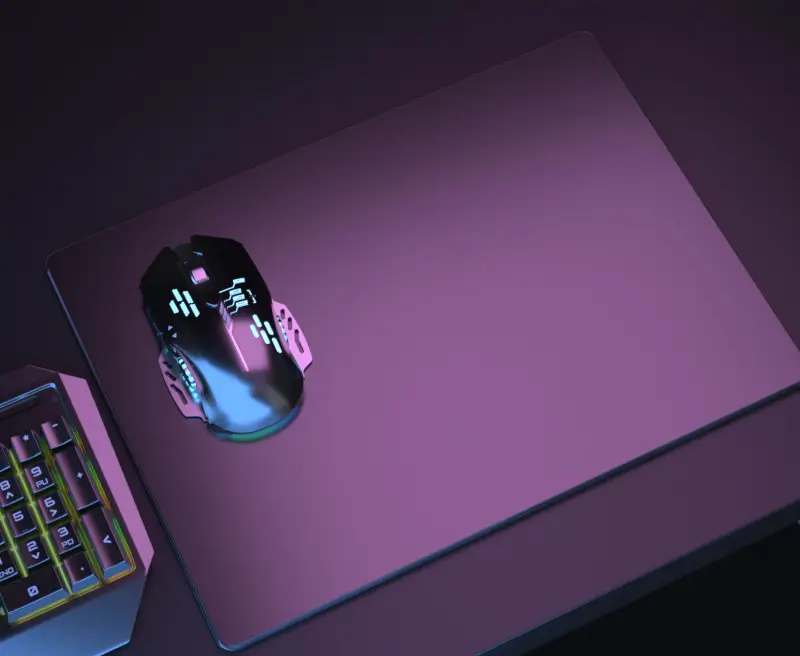
A glass mousepad business is a brand or product line built around hard-surface mousepads made from tempered or specially processed glass, usually for gaming (E-sport), premium desk setups, or branded accessory markets. Unlike standard cloth mousepads and silicone mousepads, glass mousepads are positioned as high-performance, high-end products. They are often marketed based on glide speed, surface consistency, aesthetics, and durability.
In practical terms, there are three common ways to enter the glass mousepad business:
- Private Label (Fast & Simple): Choose a ready-made product, slap your logo on it, and launch quickly.
- ODM (Semi-Custom): Use the factory’s existing manufacturing foundation, but customize specific details, like size, surface friction, prints, base design, packaging and other details, to make it uniquely yours.
- OEM (Fully Custom): Build a completely new product from scratch, providing your own engineering specs, structure, visual design and more.
For most new brands, ODM is the sweet spot. It provides much better brand differentiation than a basic Private Label, while saving you the high costs and long development times of a fully custom glass mousepad project.
Why Glass Mousepads Are Growing in Popularity in 2026?
The rise of glass mousepads is closely tied to the premiumization of gaming accessories. Buyers are no longer looking only for a basic surface under a mouse. They care about speed, control, consistency, durability, and the overall feel of their setup. Large gaming media outlets continue to review both cloth and hard-top pads in 2026, while newer reviews of glass mousepads highlight smooth glide, micro-textured surfaces, and long-term consistency as major selling points for competitive players.
At the same time, leading glass mousepad brands are educating the market with more technical product positioning. For example, current premium products emphasize features such as micro-etched glass surfaces, tempered construction, silicone anti-slip bases, ultra-low profiles, and carefully tuned tactile feedback. These are not generic desk accessories anymore. They are performance products with clear specification language and a defined user experience.
This is good news for new brands. A premium category with technical storytelling creates room for differentiation. Buyers are willing to compare surfaces, sizes, textures, and aesthetics. That means a well-positioned brand can still enter the market, provided the product and presentation are strong enough.
Who Buys Glass Mousepads?
The glass mousepads market is divided into four distinct buyer personas:
- Competitive Gamers: Focused purely on performance. They obsess over fast glide, precise micro-adjustments, friction levels, and repeatable mouse movement (especially in FPS games).
- Premium Desk Setup Enthusiasts: Driven by aesthetics. They may not play esports, but they are willing to pay top dollar for clean, modern, and high-end accessories that elevate their workspace.
- Collectors & Community Fans: Driven by exclusivity. This audience buys limited editions, special anime/graphic drops, and branded collaborations.
- B2B Buyers (Resellers & Brands): Driven by business potential. These are distributors or accessory brands looking for a reliable manufacturing partner to help them launch their own white-label or ODM product lines.
Understanding these customer groups matters because your product direction changes depending on who you serve. A brand built for serious FPS players will not look, feel, or sell the same way as a brand built for aesthetic desk setups or creator merchandise.
How to Validate Demand Before Launching?
The fastest way to lose money in this category is over-ordering inventory before validating your product. Use a lean, disciplined approach to test the market:
- Step 1: Analyze the “Why” (Market Research):
Scour Amazon, Reddit, YouTube reviews, and DTC brands. Don’t just check if glass pads are selling—figure out why buyers choose one brand over another. Are they buying for superior speed, exclusive artwork, better packaging, or a cheaper price point? - Step 2: Start with 1 or 2 “Hero” SKUs:
Do not launch a massive catalog. Begin with one primary size, one or two colorways, and a single, clear marketing angle (e.g., “The ultimate speed pad” or “The minimalist setup pad”). A focused launch is easier to test, market, and improve. - Step 3: Test, Tweak, and Validate:
Send prototypes to content creators and beta testers before scaling up production. Gather feedback on mouse-skate compatibility, surface feel, and packaging durability. (Note: Glass breaks—evaluating shipping damage rates during this phase is crucial). Only scale your inventory once you know exactly which specs and marketing messages convert.
Specs That Matter for Glass Mousepads
The details of glass mousepads are not secondary in this category. They are the category.
Glass Material and Tempering
A glass mousepad must feel premium, stable, and safe in daily use. That means the glass material, strengthening process, and edge treatment all matter. Premium products in the market currently emphasize tempered construction and engineered surface consistency rather than untreated decorative glass.
Surface Texture and Glide Feel
This is one of the most important decision points. Some users want a very fast, smooth glide. Others want speed with a little more stopping power and tactile feedback. Premium brands are now describing their surfaces in terms such as micro-etched, slight texture, faceted pattern, or speed-oriented glide. That tells you clearly where the market is heading: the surface is not just “glass.” It is a performance layer. Actually, it is all
Thickness and Profile
Current premium glass mousepads are often built around low-profile structures in the roughly 3.2 mm and 4 mm total thickness range, depending on the glass, print, and silicone base structure. Thickness affects feel, weight, edge comfort, and packaging requirements. And, more and more customers trend to thicker glass mousepads, like 2mm thick, 1.5mm thick, even 1mm thick.
Base Structure
A glass mousepad without a stable base will feel poor in real use. Anti-slip silicone bases are common in premium products because they improve desk grip and reduce unwanted movement.
Size
Common premium sizes today are significantly larger than traditional office mousepads. Full gaming-ready formats like 350x300mm, 490*420mm, 500*400mm are already established in the market.
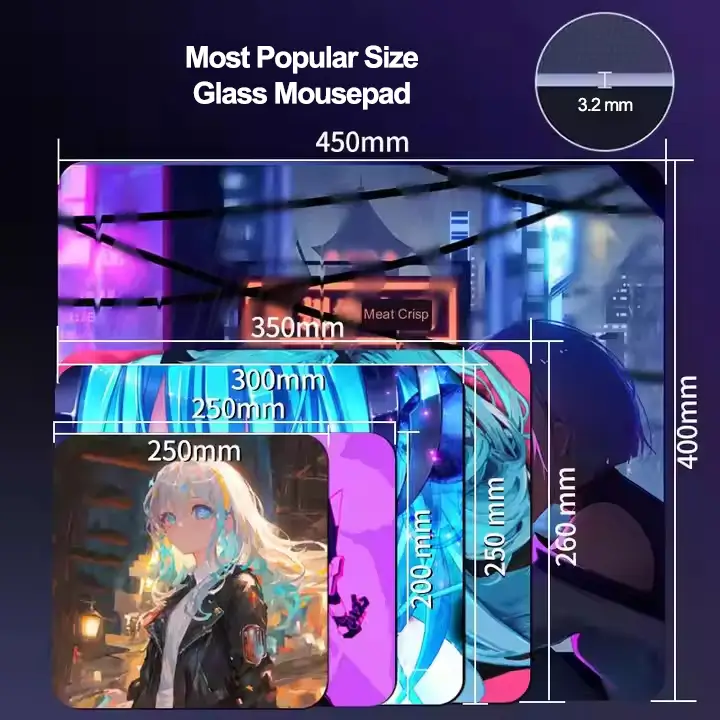
However, when building a brand, you only need to select a few of these standard sizes for your initial launch, while offering custom sizing as an additional option.
Visual Customization
For brand owners, size and surface feel are only half the story. Logo position, artwork style, color system, underside print design, and retail packaging all shape the final brand impression. In other words, even when the technical structure is strong, weak visual design can still make the product feel generic.
Sourcing and Manufacturing Options
When building a glass mousepad brand, you usually have three sourcing routes: private label, ODM, and OEM.
- Private label is the fastest and simplest. It works well for early market testing, but usually offers the least differentiation.
- ODM is often the most practical model for new brands. You can customize the product enough to build your own identity, while still using an existing production base that reduces risk, tooling complexity, and lead time.
- OEM makes the most sense when you want to create a stronger product moat. For example, you may want your own edge shape, surface tuning, exclusive dimensions, premium box structure, bundled accessories, or distinct printing process.
For glass mousepads in particular, choosing a supplier with real glass-processing experience is critical. This is not a standard textile sourcing project. The manufacturer needs to understand glass cutting, strengthening, edge treatment, print compatibility, surface quality, packaging protection, and outgoing inspection. That is exactly why a specialized glass manufacturer is a better fit than a general trading company.
How to Price Your Glass Mousepads?
A good price is not just based on manufacturing cost. It is based on your full landed business model. You need to calculate:
- Product Cost
- Custom Packaging Cost
- Freight
- Duties If Applicable
- Warehouse Handling
- Breakage Allowance
- Platform Fees
- Marketing Cost
- Target Margin
If you plan to sell on Amazon, your pricing must absorb platform fees, ad spend, and replacement risk. If you plan to sell DTC, your product page, content creation, and creator seeding costs become more important. If you plan to sell wholesale, you must leave enough room for distributor margin.
A common mistake is pricing a glass mousepad like a normal mousepad. That usually fails because this category carries higher production value, heavier shipping weight, and higher protective packaging requirements. It should be priced as a premium accessory, not as a low-cost add-on.
Packaging, Shipping, and Breakage Control
This is one of the biggest make-or-break areas in the business. A beautiful glass mousepad with weak packaging is not a product. It is a return problem waiting to happen. Your packaging system should include:
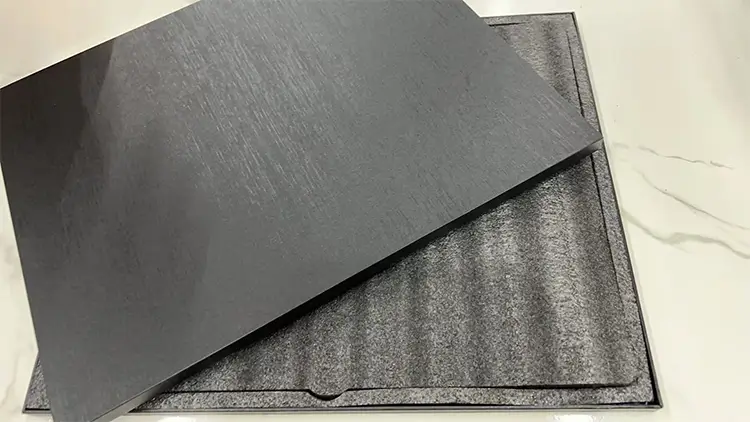
- Corner Protection
- Stable Inner Cushioning
- Rigid Retail Box Design
- Stronger Outer Shipping Carton
- Carton Drop Resistance
- Pallet or Master-carton Planning for Bulk Shipment
For e-commerce brands, especially Amazon sellers, packaging design must account for both branding and transport survival. For wholesale and B2B projects, carton efficiency and stacking performance become more important.
A good manufacturer does not treat packaging as an afterthought. Packaging should be engineered together with the product, especially when the item is glass, heavy, and premium-priced.
Quality Control and Testing Standards
Quality control is one of the fastest ways to separate serious brands from short-lived ones. For glass mousepads, your inspection process should cover:
- Incoming Glass Quality
- Dimensional Accuracy
- Edge Finish and Safety
- Flatness
- Print Consistency
- Base Adhesion
- Surface Feel Consistency
- Packaging Integrity before Shipment
You should also evaluate practical use conditions. Does the mousepad stay stable on the desk? Does the edge feel comfortable over long sessions? Does the logo or underside artwork stay visually clean? Does the packaging survive real distribution conditions?
If you are building a long-term brand, repeatability matters more than one good sample. Your manufacturer should be able to deliver stable production quality from sampling to mass production.
Branding and Positioning for Gamers
A glass mousepad brand cannot win on material alone. It needs a clear identity.
Some brands position around pure speed. Others lean toward precision and control. Some target premium desk aesthetics. Others grow through limited drops, creator collaborations, or collector-style branding.
The key is to avoid being vague.
Do not tell customers only that your product is “high quality.” Tell them what kind of experience it is built for. Fast flicks? Smooth tracking? Quiet refined glide? Premium minimalist setup? Competitive FPS play? Modern desk display?
Your packaging, color palette, product photography, and copywriting should all support that same promise. The strongest brands feel consistent from product page to unboxing.
Sales Channels: Amazon, DTC, Wholesale, and B2B
A new glass mousepad brand usually does best when it chooses its first sales channel carefully instead of trying to do everything at once.
- Amazon offers fast exposure and search demand, but competition, fees, and return handling are real.
- DTC gives you more brand control, better storytelling, and stronger long-term customer ownership.
- Wholesale works well if you have stable product quality, clean packaging, and enough margin structure.
- B2B can also be a useful path, especially for custom branded projects, gaming cafés, promotional campaigns, distributor programs, or regional partnerships.
In many cases, a smart launch path is: start with DTC or controlled marketplace testing, refine the product, then expand into Amazon or wholesale once the product and packaging are stable.
Marketing Strategy for a New Glass Mousepad Brand
Marketing for glass mousepads is highly visual and highly experience-driven.
The strongest content usually shows:
- Glide Performance
- Close-up Surface Detail
- Comparison versus Cloth Pads
- Premium Desk Setup Photography
- Unboxing Experience
- Creator Review Reactions
- Consistency over Time
Short-form videos work especially well because buyers want to see how the surface looks, how the mouse moves, and how the product fits into a setup. Creator seeding is also effective because this category benefits from tactile demonstration and niche trust.
But marketing only works well when the product is ready. If your product photos are strong but your packaging is weak, or your surface is inconsistent, the market will correct that very quickly through reviews.
Common Mistakes When Starting a Glass Mousepad Business
One common mistake is choosing a supplier that has no real glass-processing capability. A factory may be able to source something that looks acceptable in a sample, but without true control over glass fabrication and protection, quality becomes unstable.
- Another mistake is over-ordering too early. New brands often commit too much capital before validating surface preference, packaging performance, or actual conversion rates.
- A third mistake is treating all gamers the same. In reality, some buyers want faster glide, some want more feedback, and some care more about the visual identity of the product than its esports story.
- Another frequent problem is underestimating breakage control. Glass products need serious packaging logic. This is not optional.
- And finally, many new brands make the product too generic. In a premium category, generic products disappear quickly.
Why the Right OEM/ODM Manufacturer Matters
For glass mousepad, the manufacturer is not only a supplier. The manufacturer is part of the product strategy. The right OEM/ODM partner helps you:
- Choose Workable Specifications
- Balance Speed and Control in the Surface Design
- Improve Safety and Edge Finish
- Create Packaging That Protects the Glass Mousepads
- Reduce Avoidable Breakage
- Maintain Stable Quality
- Move from Sample Stage to Scalable Production
That is where TFT Cover Glass adds real value. As a professional glass fabricator, we understand that a successful glass mousepad is not defined by one feature alone. It is the result of material choice, glass processing, edge treatment, print integration, packaging design, and production consistency working together. If you want to build your own glass mousepad brand, choose a manufacturer that can support the whole project, not just the order.
FAQ About Glass Mousepad Businesses
Is a glass mousepad business profitable?
It can be, especially if you position glass mousepad as a premium accessory and manage landed cost, packaging, and channel margin carefully.
Should I choose OEM, ODM, or private label?
For most new brands, ODM is a strong starting point. It balances speed, customization, and development cost.
What thickness is best for a glass mousepad?
That depends on your product design, but premium products in the market currently use low-profile structures around the 3.2 mm to 4 mm range overall.
Can I customize size, logo, print, and packaging?
Yes. A capable OEM/ODM manufacturer should support these customizations based on your target market and sales channel.
How do I reduce shipping breakage?
Use engineered protective packaging, not just a gift box. Corner protection, cushioning, rigid outer packaging, and transit testing all matter.
What MOQ is suitable for a new brand?
That depends on your level of customization. For many new projects, it is better to start with a manageable MOQ and validate before scaling.
Conclusion
A glass mousepad brand can absolutely be built in today’s market, but it should be approached as a premium product business, not a casual accessory play.
The opportunity is real. The category is growing. Buyers are paying attention to performance, durability, design, and brand identity. But the brands that last are the ones that validate demand early, define the right specifications, control packaging and quality, and work with a manufacturer that understands the product at a technical level.
For brands that want to launch through Amazon, DTC, wholesale, or B2B channels, the best starting point is simple: build the right product with the right OEM/ODM manufacturer.
TFT Cover Glass helps customers develop custom glass mousepads with OEM/ODM support, tailored specifications, custom branding, protective packaging, and reliable production quality for long-term growth.




 EN
 FR
 DE
 ES
 PT
 IT
 NL
 DA
 RU
 AR
 TR
 JA
 KO
 ID
 UK
 TH
 VI
 PL
 MS
 ET
 EL